A training pipeline organizes the path from raw data to a working language model: prepare and tokenize data, define the model, optimize its parameters, and generate text for evaluation. The implementation-oriented view connects architectural components with the scripts and infrastructure required to train them as one functional system. section 6.0 section 6.6
Figure 1.9 The four-stage roadmap for building a mini-DeepSeek model in this book. We will progress from foundational concepts (Stage 1) and core architecture (Stage 2) to advanced training (Stage 3) and post-training techniques (Stage 4), implementing each key innovation along the way.
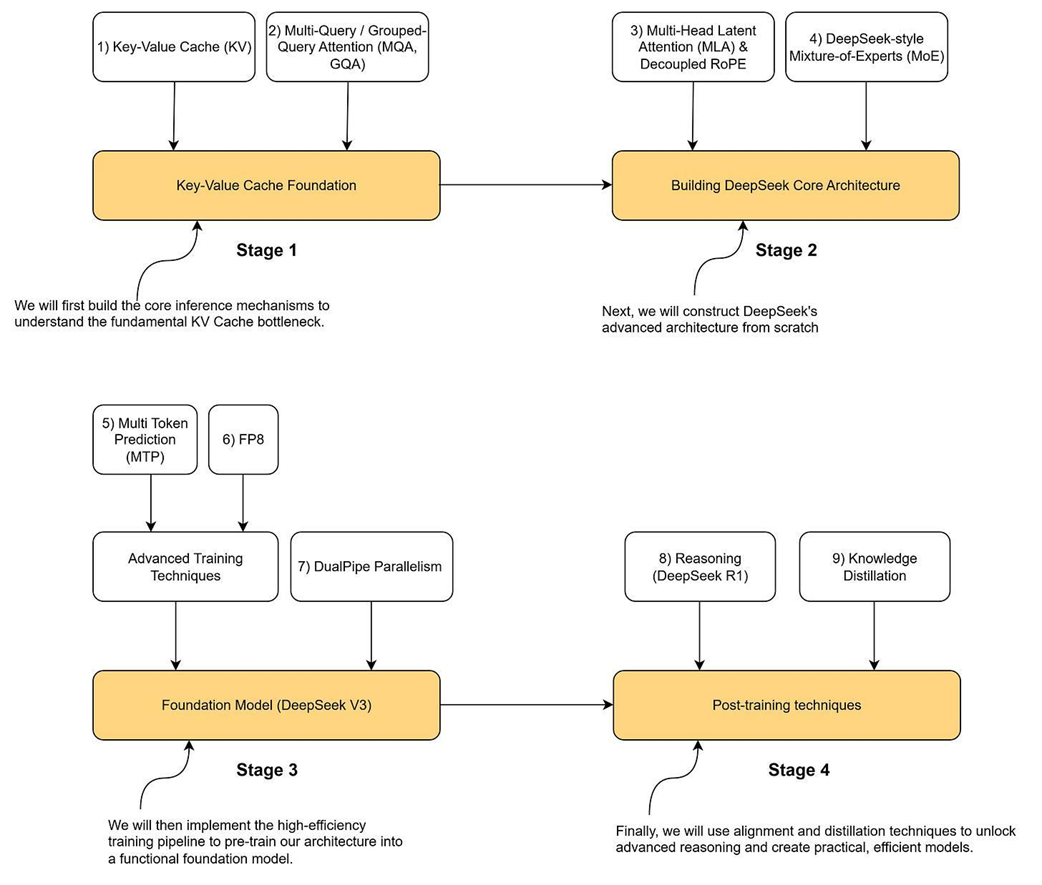
Use the roadmap to locate the pipeline between architectural construction and post-training: the training stage combines model innovations with optimization techniques before later refinement. section 1.3
A practical pipeline typically proceeds through these operations:
- Prepare a dataset by selecting raw text, tokenizing it into numerical representations, and storing it for efficient loading. section 6.1
- Assemble the model architecture and training scaffolding, then run a training script that optimizes its parameters. section 6.0
- Generate text with a sampling script after training to inspect the model's behavior and results. section 6.0
- Scale execution with gradient accumulation, data parallelism, or pipeline parallelism when memory, model size, or training time becomes limiting. section 6.6
Mini-DeepSeek training system
A runnable implementation combines a prepared dataset with a MiniDeepSeek model, a training script, and a text-generation script. Gradient accumulation simulates larger batches on constrained hardware; data parallelism replicates a model across GPUs; pipeline parallelism distributes layers when the model no longer fits on one device. For large mixture-of-experts systems, DualPipe overlaps computation with communication to reduce pipeline inefficiency. section 6.0 section 6.6
The same pattern extends beyond foundation-model pretraining. Reinforcement-learning systems combine data curation, supervised learning, reward-driven optimization, rejection sampling, and hybrid rewards; distillation systems connect teacher and student models through a loss and training loop. section 7.7.4 section 8.6






























































