A container is an isolated runtime instance launched from an image containing application code and its dependent libraries. In a model-training platform, a host service launches containers through one standard mechanism instead of configuring a separate process environment for every training implementation. section 3.2.2
This boundary decouples training execution from training-service logic. The service remains agnostic to the model architecture and algorithm, while the container supplies the executable training environment. A communication protocol connects both sides by defining parameters such as dataset, hyperparameters, model location, and metrics location. section 3.2.2
A containerized training workflow typically follows these responsibilities:
- Queue a training request and assign it a job identifier. section 3.3.4
- Launch the container when the Docker engine has sufficient capacity. section 3.3.4
- Pass training parameters and the data path into the container as environment variables. section 3.3.4
- Track container state and move the associated job through launching, running, and finalized queues. section 3.3.4
The same packaging pattern applies beyond training. Training and inference components are packaged as Docker containers, launched and tracked by host services, then registered with a metadata and artifacts store under a shared handle so services can select the intended code. section 10.2.2 section 10.2.3
Launching and monitoring a training container
A tracker takes the next queued job when capacity is available, builds environment variables such as TRAINING_DATA_PATH, launches the Docker container, and records its identifier. It then queries Docker for status changes, moving the job from launching to running and finally to finalized after success or failure.
Figure 3.4 A training service launches a Docker container to perform model training instead of running the training code directly as a process.
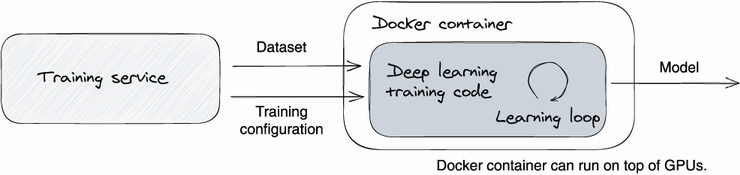
Use the architecture figure to see how a training service launches a container instead of directly spawning training code. section 3.2.2


























