liveBook · Manning

Container

As explained in Machine Learning for Tabular Data: XGBoost, Deep Learning, and AI

A software construct that packages an application with its dependencies so it can run predictably across different environments.

A container packages an application with its dependencies so it runs predictably and efficiently across environments. In machine-learning pipelines, this makes training easier to automate and reproduce. section 11.3.2 section 11.3.3

Containers support practical ML operations in several ways:

  • Bundle the required Python libraries with the training code instead of depending on each execution environment. section 11.3.3
  • Use prebuilt images for frameworks such as TensorFlow, PyTorch, and XGBoost. section 11.3.3
  • Scale demanding training across multiple compute engines, although a single node is sufficient for a small real-estate prediction problem. section 11.3.3

Passing training artifacts

Treat the container as a self-contained machine: local files are not automatically available. Store training, validation, test, and configuration artifacts in Cloud Storage, then pass their URIs through environment variables or job arguments. section 11.3.4

Figure 11.30 Training code interactions with external files
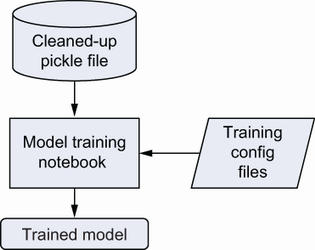
Use the filesystem interaction diagram to see why containerized training must receive external artifacts through explicit paths. section 11.3.4


How Machine Learning for Tabular Data: XGBoost, Deep Learning, and AI covers it

How deep it goes
Defines containers and explains dependency packaging, reproducibility, scaling, and artifact access, but defers detailed container technology.
Examples
Uses TensorFlow training, a Kuala Lumpur real-estate prediction problem, and Cloud Storage URIs for external artifacts.
What it assumes
Assumes basic training-pipeline context and teaches container purpose, dependency packaging, and external-file handling.
What you can do after
Operate containerized Vertex AI training by packaging dependencies and supplying artifact locations through environment variables or job arguments.
How it connects
Connects containers with Docker, ML pipelines, Vertex AI, Cloud Storage, prebuilt images, and distributed training.

Also explained in

Compare how 27 books explain container →

Related concepts

This explainer was generated by Manning's knowledge graph from the text of Machine Learning for Tabular Data: XGBoost, Deep Learning, and AI. The section links point to the parts of the book it draws on.