A container packages an application with the runtime, system tools, libraries, code, configuration, and settings required for execution. Containerized applications can modernize VM workloads without requiring a complete rewrite. section 15.0 section 16.6
A containerized deployment typically separates application responsibilities from platform responsibilities:
- Application artifacts hold user-mode system content and application services. section 15.3.2
- Kubernetes manages networking, logging, monitoring, OS kernels, drivers, and persistent-volume integration. section 15.3.2
- Container density can exceed VM density because multiple containers share underlying infrastructure and avoid duplicating operating-system resources. section 15.1.1
- Security depends on correct platform configuration: shared host kernels create breakout risk, while hypervisors also have exploitable vulnerabilities. section 13.2
Migrating a VM workload
A migration workflow can produce a Docker image, Dockerfile, deployment YAML, user services, and persistent-volume definitions from a virtual machine. The resulting artifacts can run on Anthos or another Kubernetes-conformant distribution. section 15.3.2 section 15.3
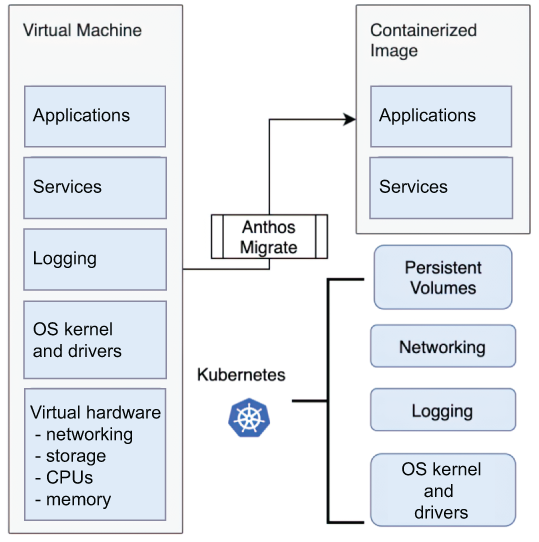
Use the architecture figure to trace how a virtual machine becomes application containers, deployment artifacts, and Kubernetes-managed storage. section 15.3.2


























