A normal distribution is a continuous probability distribution shaped like a symmetric bell around its mean. Values near the center are more common than values farther away. section 12.9
Its practical value here is predictable randomness: sample weights for an artificial neural network or sample Gaussian noise for a diffusion model. section 9.6 section 12.9
Two uses make the idea concrete:
- Initialize ANN weights with random values sampled from a standard normal distribution before training. section 9.6 section 9.8
- Generate random noise for diffusion by sampling values centered around zero, then combine that noise with image pixels. section 12.9
Adding noise to an image
A diffusion process calculates how much original signal remains at a timestep using cumulative alpha values. It then combines the preserved image with scaled random noise. Repeating this across timesteps turns a clear happy-face image into a noisy one; the resulting image-and-noise pairs train a model to predict what noise to remove. section 12.9
Figure 12.16 A view of probability of selection in a normal distribution
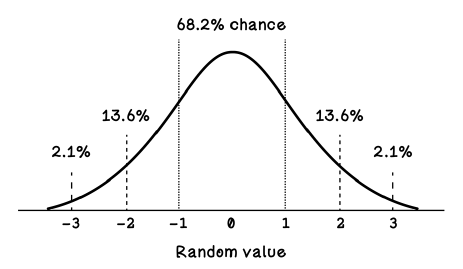
Use the probability view to see why samples near the center occur more often than samples farther from zero. section 12.9















