Structured data organizes information into predefined fields, such as rows in SQL records. For retrieval, those records must be transformed into searchable text and vectors rather than uploaded as raw database rows. section 3.2 section 3.4
A production ingestion workflow processes structured records as follows:
- Connect to the SQL database and fetch records in batches to avoid database and retrieval bottlenecks. section 3.2
- Summarize each record into text, remove unnecessary or unusual characters, and generate an embedding. section 3.2 section 3.4
- Package the text and vector as a search document, then upload it to Azure AI Search. section 3.2
- Keep the index synchronized by updating modified records and removing deleted records. section 3.4
Figure 3.3 Workflow for ingesting structured SQL data into Azure AI Search. The process begins by connecting to an SQL database and fetching records in batches. Each batch is summarized, cleaned, embedded, and prepared as documents for upload. The pipeline loops through remaining records until all data is processed and uploaded.
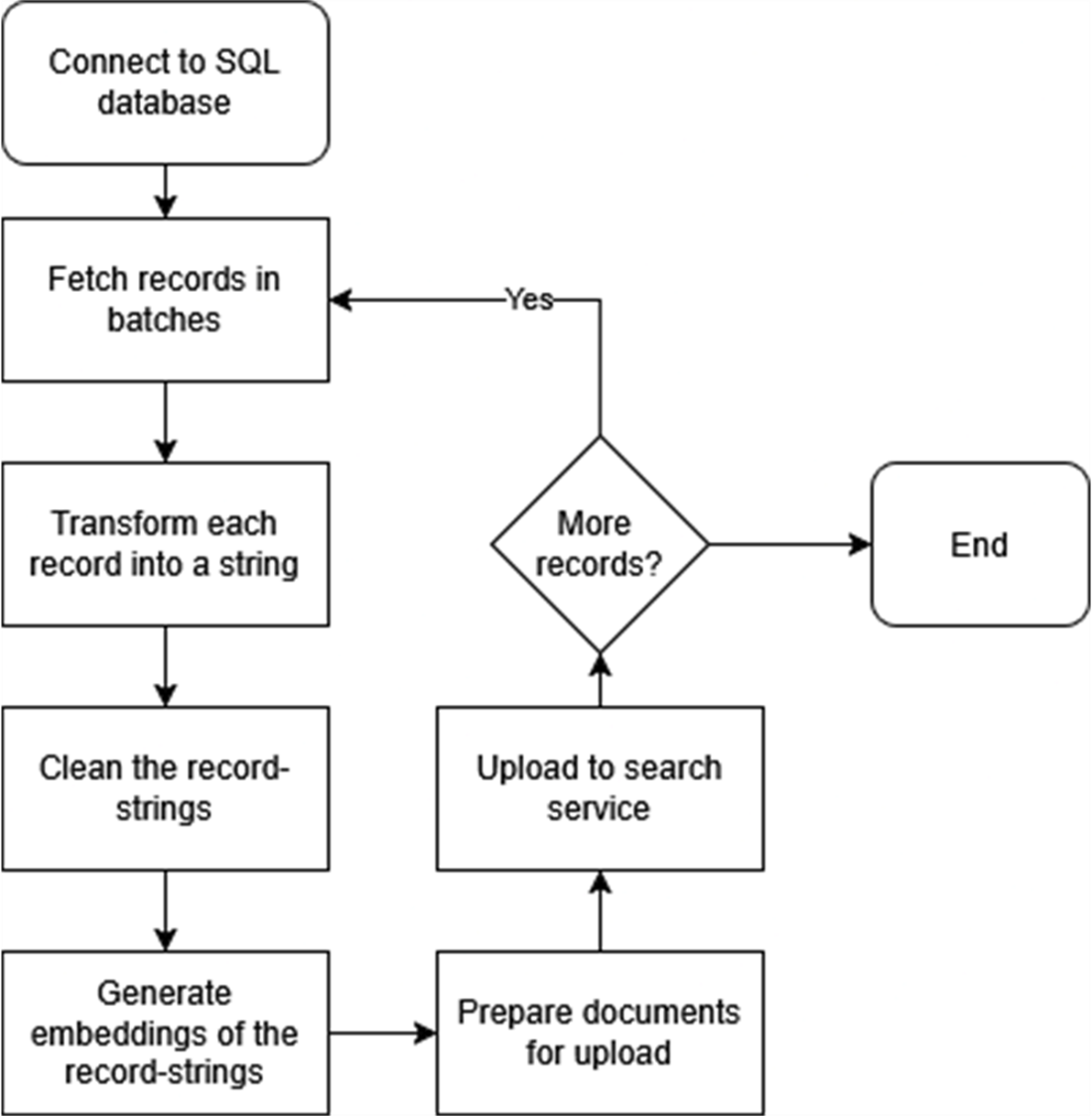
The workflow diagram shows batch retrieval, record summarization, cleaning, embedding, document preparation, upload, and looping through remaining records. section 3.2