Structured data is organized according to a predefined schema, typically as fields, records, or tables. In fraud detection, transaction records and metadata such as IP addresses, timestamps, country codes, and click frequencies are structured or tabular data. section 1.5 section 1.5.1
The available amount and modality of structured data shape the detection strategy:
- Use rules-based systems when only a limited amount of structured data is available. section 1.5
- Use machine learning or deep learning when large amounts of structured data support scalable fraud detection. section 1.5 section 1.7
- Combine structured metadata with raw text, audio, or images to form a semi-structured fraud-detection setup. section 1.5.1 section 1.5.2
Fraud-detection records
A credit-card fraud dataset can contain tabular transaction records. A phishing detector can use the sender’s IP address, country code, and receipt time as structured fields, while adding email text makes the data semi-structured. Identity-fraud systems can likewise use IP address, mouse-click frequency, typing speed, and transaction patterns as structured cues. section 1.5 section 1.5.1 section 1.5.2
Figure 1.14 Three ways of categorizing online fraud: the industry or sector in which fraud is perpetrated, the nature of the fraudulent attack, and the modalities of data involved.
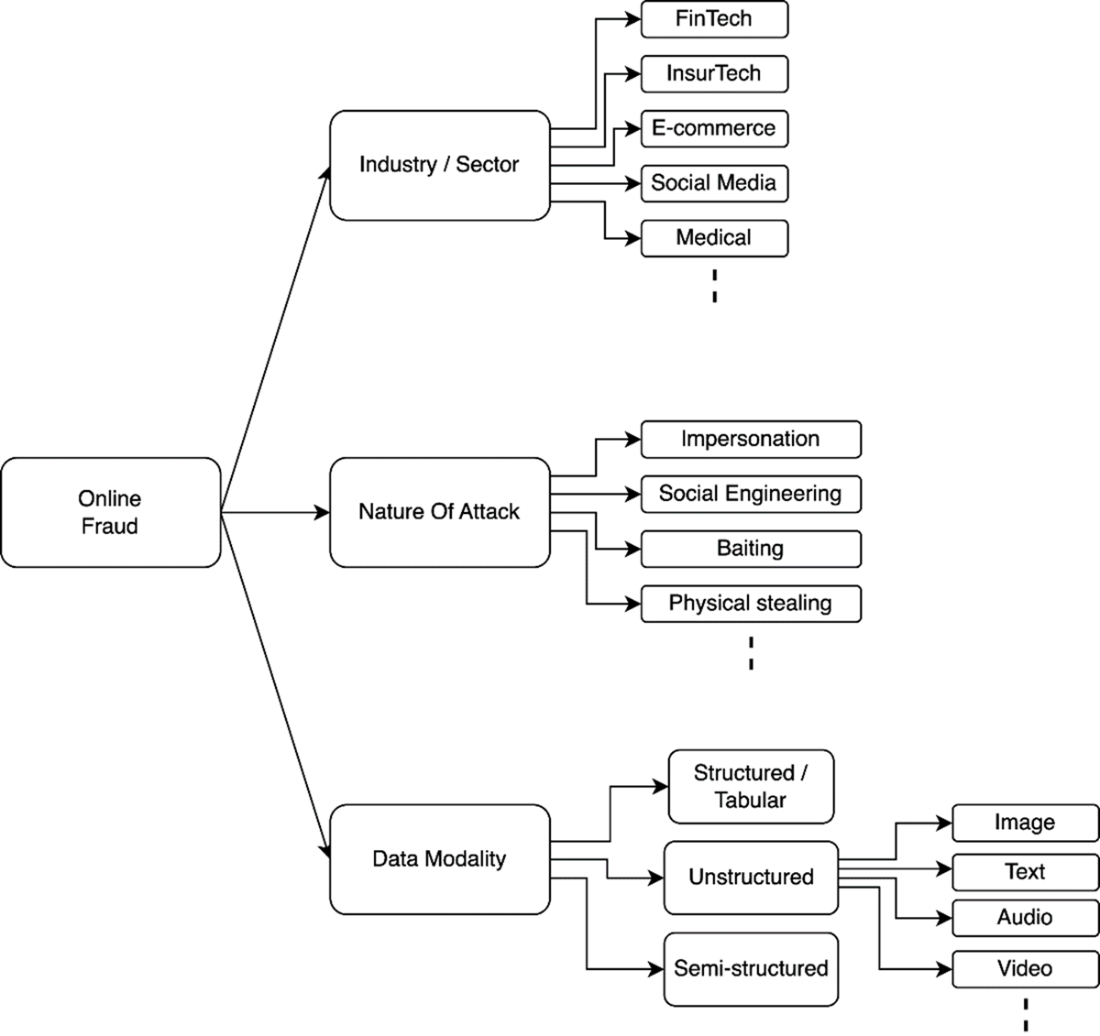
Use the modality comparison to distinguish tabular structured data from unstructured text or images and mixed semi-structured datasets. section 1.5