An AI agent is an automated software component that compares an API gateway’s desired configuration in an environment repository with its deployed state, then acts when they differ. section 1.5.6
A deployment agent provides a continuous feedback and control loop:
- Detects drift caused by direct administrative changes or intentional repository changes. section 1.5.6
- Deploys the desired configuration so the runtime state matches the version-controlled state. section 1.5.6
- Supports self-healing, auditable changes, and rollback through Git pull requests and git revert. section 1.5.6 section 1.7
Restoring a changed API gateway
An engineer changes gateway configuration through an administrative UI, creating drift from the environment repository. The agent detects the divergence and redeploys the repository’s desired state. If a repository change causes failure, the team can use git revert to restore a previously working configuration. section 1.5.6 section 1.7
Figure 1.4 APIOps is based on the GitOps approach of having the desired configuration state of the API gateway, and services are defined declaratively in an environment repository in Git. Dev teams make all changes to the desired system state via Git, and operations teams can review and approve. Software agents automatically detect any difference between the deployed state and the desired state (as defined in the environment repository). If the agent detects a drift, it automatically deploys the desired state to the specified environment so the actual state matches.
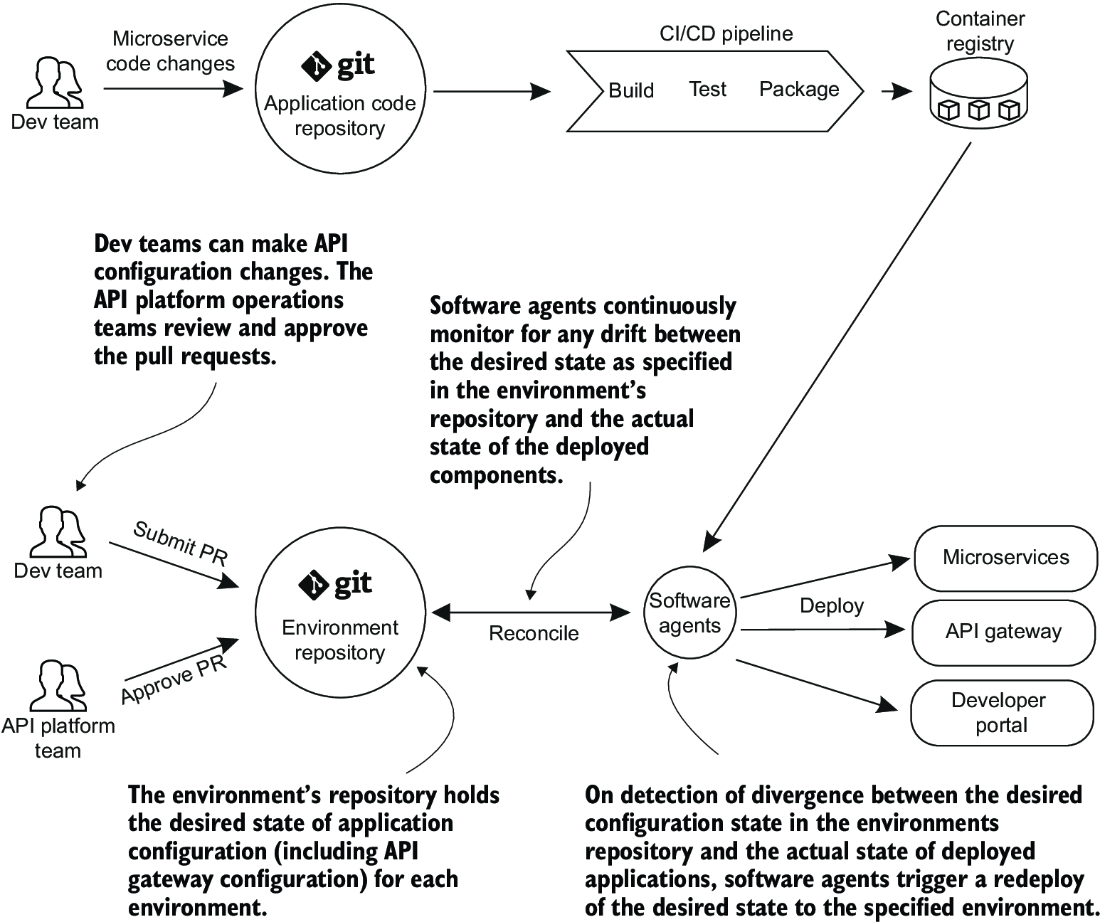
The GitOps diagram connects declarative API gateway and service configuration, reviewed pull requests, automated drift detection, and redeployment. section 1.5.6
































