An AI agent is an artificial intelligence system that independently plans and performs multiple steps toward a specified task. In financial research, it can collect web data, analyze financial statements and news, assess sentiment, and produce a report. This turns a largely manual analytical workflow into an orchestrated process, while leaving uncertainty and validation responsibilities with the user. section 1.3.2 section 9.1.2
Useful agentic patterns include:
- Tool use lets an agent select external APIs, libraries, or specialized services, such as stock-price retrieval or sentiment analysis, and integrate their results. section 9.1.2
- Planning lets an agent define a goal, inspect constraints and dependencies, construct a sequence of actions, and monitor execution. section 9.1.2
- Reflection adds a cycle of action, evaluation, and adaptation, allowing the agent to revise risk thresholds, strategies, or execution timing. section 9.1.2
A practical workflow can begin with a prompt repository and structured research process, then export findings to Notion. Frameworks add abstractions such as prompt enhancement, retrieval-augmented generation, resource access, and workflow orchestration. The implementation choice is strategic: no-code interfaces such as n8n reduce initial complexity, while code-based approaches provide more control and customization. section 9.0 section 9.3
Researching a company with LangChain
A LangChain agent can combine an LLM with Yahoo Finance news tools and answer a question such as “What happened today with Microsoft stocks?” It can also use custom data providers, extending the research workflow beyond a single prompt. section 9.3.1
Figure 9.1 A reference workflow for an AI agent
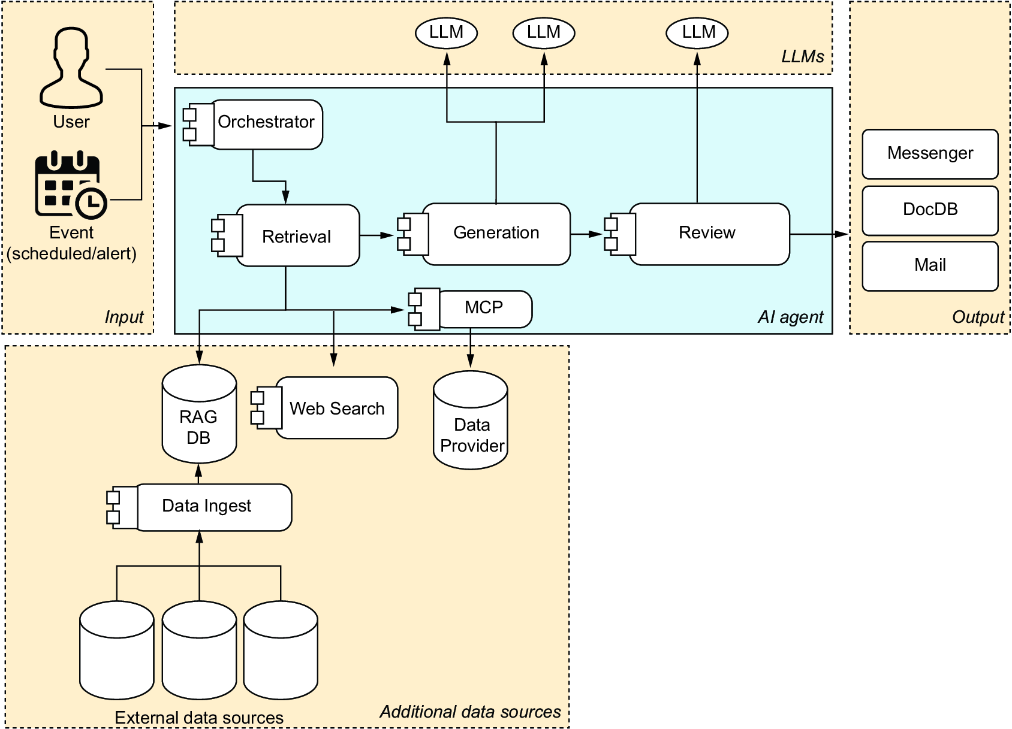
Use the reference workflow to inspect how an agent connects goals, tools, intermediate steps, and results. section 9.1.2
AI agents remain fallible: they may lack context, make mistakes, or produce hallucinations. Validate important financial or tax suggestions with appropriate expertise, and avoid replacing deliberate problem-solving with repeated prompts and unexamined outputs. section 13.1
































