A retention dashboard can flag customers at risk of leaving, but someone still has to decide what to do. An AI agent closes part of that gap: it gathers context, reasons about a goal, and uses tools to carry out a multistep workflow within defined boundaries. In finance, those boundaries matter as much as the automation. section 14.0 section 14.1 section 3.1.3
An agent differs from an IF-THEN rule that sends a fixed email whenever losses and login counts cross thresholds. It can consider additional context, such as recent messages or market events, before recommending an action. An AI agent may still follow a largely predetermined workflow: finding posts, fetching a price, and drafting a summary. Agentic AI describes the more ambitious case in which a system plans subtasks from a higher-level goal. Neither implies unrestricted autonomy. section 14.1.1 section 3.3.4
A retention agent fits into four connected layers:
- Data asset: expose customer behavior and other relevant context through callable tools, such as get_user_context. section 14.1.2
- Modeling: use an inexpensive churn model to filter candidates, then use an LLM for nuanced interpretation and strategy generation. section 14.1.2 section 14.7
- Application: run an executor that repeatedly gathers context, reasons, and prepares a recommendation rather than making one isolated LLM call. section 14.1.2 section 14.7
- Strategy and monitoring: require approval for consequential actions, log steps, and test whether interventions improve retention rather than merely counting recommendations. section 3.3.4 section 14.7
An at-risk investor goes quiet
Suppose a customer with heavy margin usage and recent losses stops visiting an investment platform. A churn score can prioritize the case; the agent can retrieve user context and cluster insights, then propose a suitable retention strategy for a person to approve. A daily Slack alert can bring that proposal to the team. The useful result is not the alert itself but a measured improvement in retention, assessed through A/B testing and translated into revenue preserved. section 14.0 section 14.7
Figure 14.1 The four-layer framework extended for agentic systems. The fundamental structure remains intact, but each layer’s implementation changes. The data asset layer now exposes data through callable tools. The modeling layer expands from traditional ML to include LLM-based reasoning. The application layer becomes an agent executor rather than a simple API. The strategy and monitoring layer adds HITL governance alongside traditional metrics.
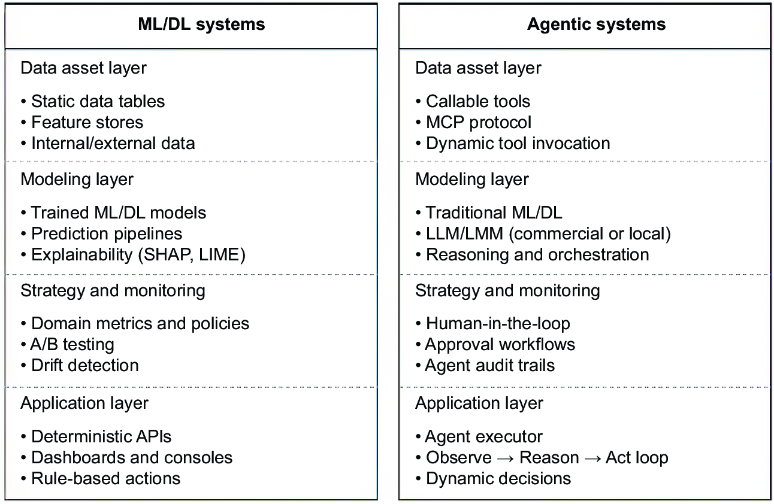
The diagram maps callable data tools, ML-plus-LLM reasoning, the agent executor, and human-in-the-loop governance to the four-layer architecture. section 14.1.2
































