An AI agent adapts its behavior and selects actions beyond merely executing a hardcoded behavioral program. Unlike an automaton, it can respond to novel situations rather than fail whenever conditions differ from its programming. section 19.2.1 section 19.2.2
The distinction rests on how systems generalize:
- Automatons apply static, context-specific rules or learned behavior; lookup tables, if-else programs, and trained deep networks can fail outside their prepared conditions. section 19.2.1 section 19.2.2
- Agents adapt on the fly to unexpected situations instead of mapping only familiar stimuli to immediate responses. section 19.2.2
- Extreme generalization uses abstraction, reasoning, situation models, anticipation, and planning to handle unprecedented experiences with little or no new data. section 19.2.2
A new problem reveals the difference
A student who memorized three years of exam questions may succeed on familiar prompts but fail on a brand-new problem. A student who understands the subject can adapt and find a way forward; the second behavior illustrates the agent-like capacity being distinguished. section 19.2.2
Figure 19.6 Local generalization vs. extreme generalization
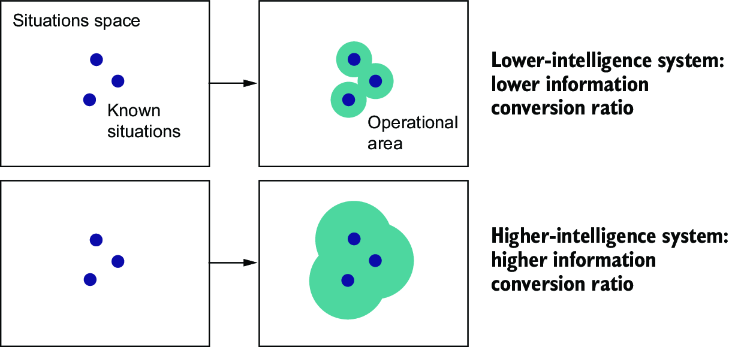
Use the comparison figure to distinguish limited, nearby variation from adaptation to fundamentally novel situations. section 19.2.2
































