An AI agent turns an LLM from a text-only responder into a system that can plan and trigger actions. The LLM supplies the reasoning; the agent supplies a toolset and a protocol for using it. This makes agents useful when an application must fetch live information, update another system, control a device, or complete a task through several decisions rather than merely generate words. section 5.0 section 5.2 section 5.5
An agent operates as a loop. It receives the user request, available tool descriptions, and results from earlier calls. It then decides whether to answer or invoke a tool with parameters. Tool output becomes new context for the next decision, and the loop ends when the agent judges the task complete. A tool is a focused computer function, such as an API call, database query, calculator, message sender, or device control. section 5.2 section 5.7
Figure 5.1 The looped life of an agent: at each iteration, it decides whether to use a tool or to respond to the user.
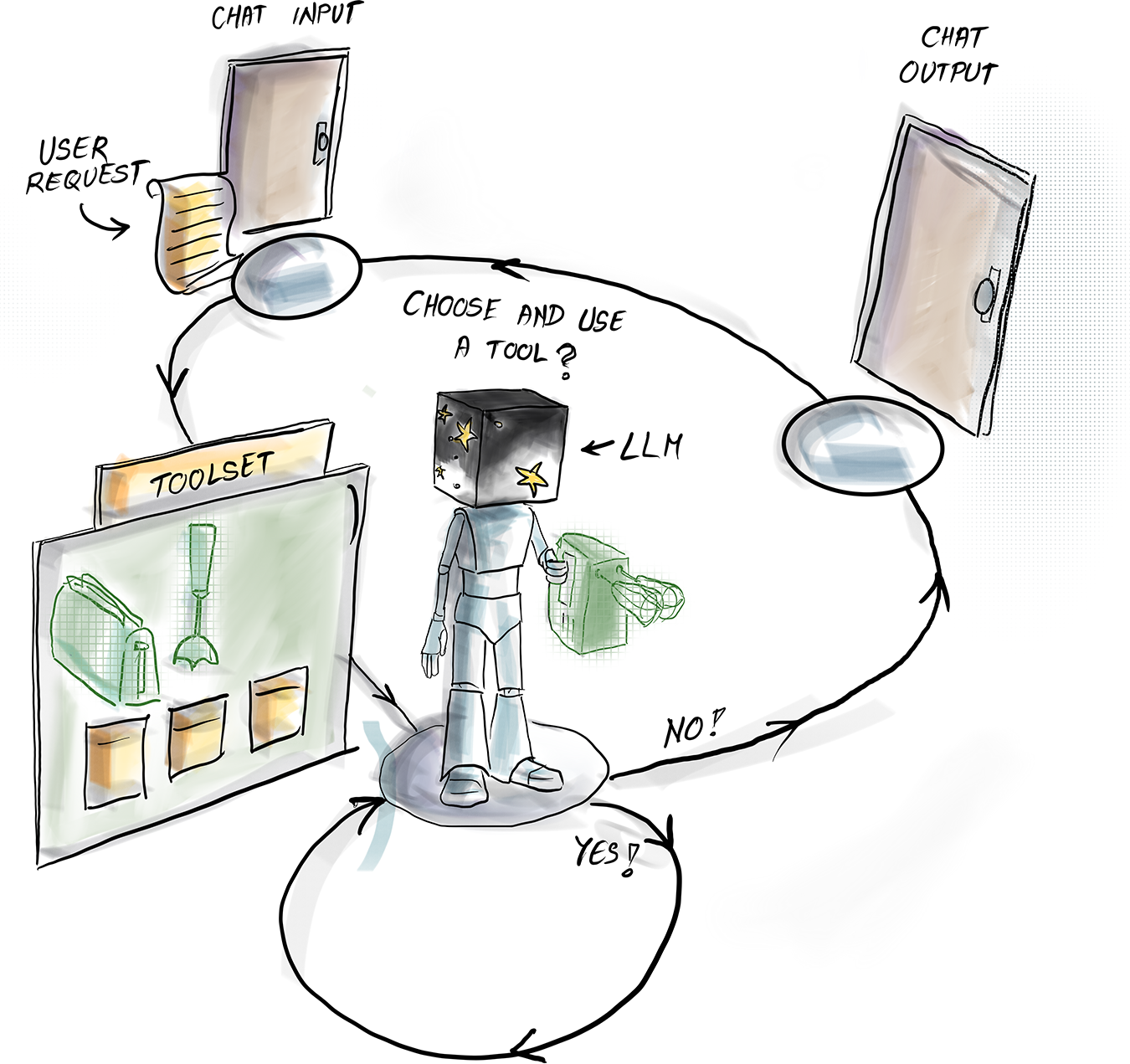
Follow the repeated decision point: the agent either calls a tool, incorporates its result, or returns an answer. section 5.2
A practical agent design starts with a task and a deliberately useful toolset:
- Identify what requires action or current information instead of a text-only response. section 5.1
- Provide tools with clear names, purposes, and required parameters so the LLM can choose and call them. section 5.2
- Give the agent instructions defining its role, boundaries, source restrictions, tool use, and response format. section 6.3
- Let it observe results and adjust a dynamic, multistep plan as conditions change. section 5.1
Making a room comfortable for sleep
A request such as “make the room comfortable for sleeping” has no fixed sequence. An agent can check temperature and light, use those results to decide on conditions, then close a window, set the thermostat, dim lights, and play background sounds. The key difference is not a single command but choosing and revising a plan from the situation. section 5.1 section 5.2
From calculator to travel planner
A calculator-equipped agent can delegate precise arithmetic instead of guessing a plausible answer. A richer travel agent can choose among web search, URL fetching, and Wikipedia tools to assemble a history-relevant itinerary from a user's destination and preferences. In Langflow, components can be placed in Tool Mode and connected to an Agent component. section 5.3 section 5.4 section 5.7
Agentic AI describes systems that operate autonomously, make decisions, and perform tasks without significant human intervention. Tool choice determines what an agent can reach: APIs, databases, files, dashboards, sensors, and other digital systems can bridge reasoning to data and action. Multiple specialized agents can also collaborate in larger agentic structures. section 5.5 section 8.6
































