An AI agent is an application that reasons about a user’s situation, chooses actions, uses external systems, and responds after completing the necessary steps. Unlike an informational chatbot, it can retrieve personalized data or change real-world state. section 10.6 section 10.6.1
A practical agent combines several capabilities:
- Interpret the request and reason about the user’s situation. section 10.6.1
- Select and call documented tools, such as APIs, database queries, or workflows. section 10.6.1 section 10.7
- Use returned results to decide whether another action is necessary. section 10.6.2
- Complete support tasks such as tracking or canceling an order instead of merely explaining the process. section 10.0 section 10.6.4
Order-status request
For “What’s the status of my order?”, a ReAct-style agent reasons that it needs order details, calls the order-management system, interprets the shipment result, and responds with tracking information and an estimated delivery date. section 10.6.2
Figure 10.19 The ReAct framework
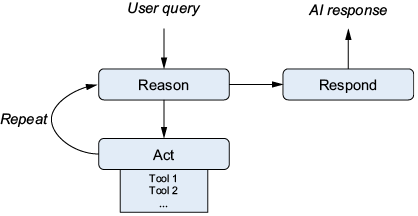
The ReAct diagram helps visualize the repeating sequence of reasoning, action, result interpretation, and response. section 10.6.2
































