Generative modeling learns patterns and distributions from data to produce new outputs. In an enterprise, those outputs might be an email, a code snippet, an image, or a design. Unlike a system focused on classifying an input or predicting a property, a generative model can create content that was not explicitly stored in its training data. section 1.2 section 1.6
Models generate outputs probabilistically, influenced by learned patterns and the input they receive. A prompt specifies the desired task and can include context, requirements, and tone. Generative AI does not understand content as humans do, and the quality and relevance of its training data affect its output. section 1.6 section 1.3
Draft an enterprise email
To draft a launch email with GPT-4, provide the announcement context, target audience, desired tone, and a request for both a subject line and body. The same model can also be prompted to extract names, organizations, locations, email addresses, and phone numbers from a message. Review the generated content or extracted fields before relying on them. section 1.3.2 section 1.3.1 section 1.4
Generative capabilities support both broad and industry-specific applications:
- Create marketing content, customer-service responses, reports, and personalized messages. section 1.4
- Generate code and other development artifacts, including documentation, tests, and refactoring suggestions. section 5.6
- Support financial scenario simulation or create healthcare documentation and personalized treatment plans. section 1.4
A model alone does not solve a business problem. Start with a small pilot and clear objectives, then select the model and data for the use case. For an enterprise chatbot, relevant internal data must be managed, ingested, and indexed; access should be limited to authorized users. Integrate the chatbot with the business applications it serves and establish governance and safety guidance. section 1.7 section 1.9
Figure 1.7 High-level overview of implementing generative AI
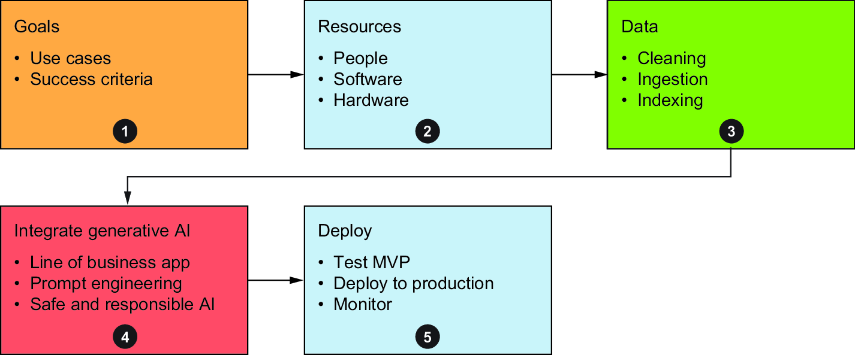
Use the workflow overview to navigate the major steps in an enterprise generative AI implementation. section 1.9
Plan for failure and cost as well as capability. Cloud deployment offers scalability but raises ongoing cost, vendor-lock-in, and privacy concerns; on-premise deployment offers more control but requires investment and expertise. Generated content can contain hallucinations, bias, sensitive material, or copyright risks. Use human oversight, and keep a person responsible for final life-and-death decisions. section 1.8 section 11.2 section 1.5































