Generative artificial intelligence (generative AI or GenAI) describes machine-learning systems that create new outputs from patterns learned from earlier data. Outputs can include text, images, audio, video, or other media, depending on what the system was trained to produce. section 1.1 section 1.9
A prompt or other input guides the generation. For example, a request to write a haiku about snow falling on pine trees produces a novel haiku by drawing on learned patterns about language, poetry, snow, and trees. Other systems may rewrite text, add detail, complete missing portions, or transform one kind of input into another. section 1.1
Figure 1.1 A simple haiku generated by ChatGPT

Use the generated haiku as a compact example of how an input prompt becomes new content. section 1.1
Figure 1.2 Generative AI takes some input (numbers, text, images) and produces a new output (usually text or images). Any combination of input or output options is possible, and the nature of the output depends on what the algorithm was trained for. It could be to add detail, rewrite something to be shorter, extrapolate missing portions, and more.
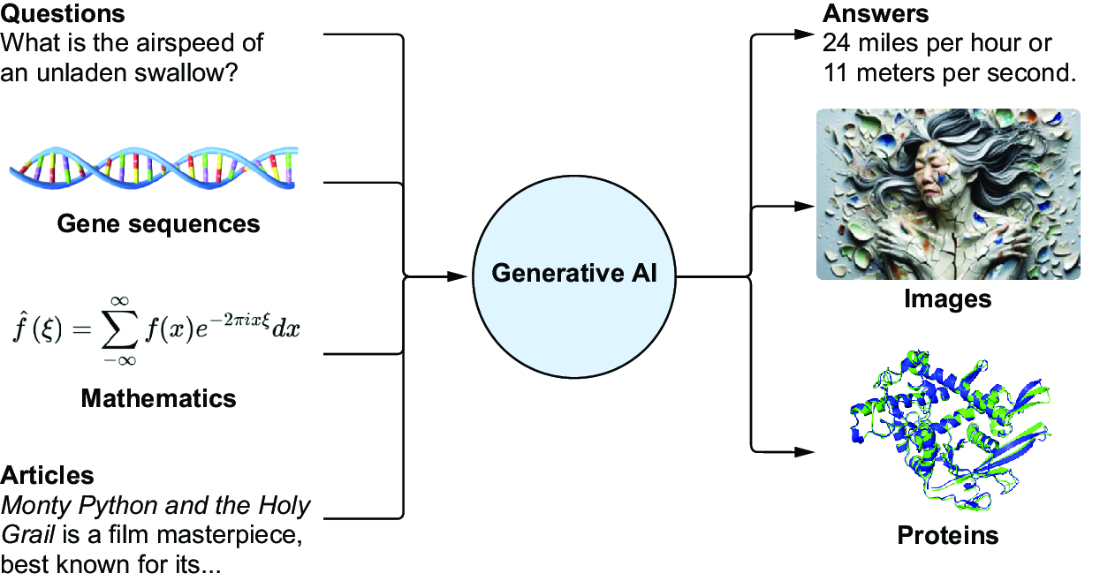
Use the input-output map to compare generation tasks across numbers, text, and images, including rewriting, detail addition, and completion. section 1.1
Large language models (LLMs) are one important part of generative AI rather than the whole field. They specialize in human language and support dialogue, instruction following, summarization, question answering, and content creation. Natural language processing connects this work with the broader effort to help computers understand, manipulate, and create human language. section 1.1 section 1.3
Generative AI is useful, but fluent output does not guarantee reliable understanding or factual accuracy:
- Treat it as a capability for producing outputs, not as proof of human-like intelligence or reasoning. section 1.9
- Check results before relying on them, especially when an application depends on accuracy, safety, or consequential decisions. section 1.0 section 1.2
- Consider whether generative AI is appropriate at all; some systems are costly to create and use, and misuse, privacy, and security require attention. section 1.9 section 9.5
A language-generation workflow
A user enters “Summarize the following text in two sentences.” An LLM processes the prompt and supplied text, then generates a concise summary that appears human-written. The result demonstrates useful synthesis, but its fluency alone does not establish that every claim is correct. section 1.3 section 1.9




























