Generative modeling learns the distribution of data so that new examples can be sampled from it. A deep generative model uses neural networks to do this. Unlike a discriminative model, which learns boundaries between classes, a generative model tries to capture the dataspace itself. section 5.0 section 5.1.1
Figure 5.1 Comparison of generative and discriminative tasks. On the left, the discriminative model learns to separate different images of boats and airplanes. On the right, the generative model attempts to learn the entire dataspace, which allows for new synthetic examples to be created such as a boat in the sky or an airplane on water.
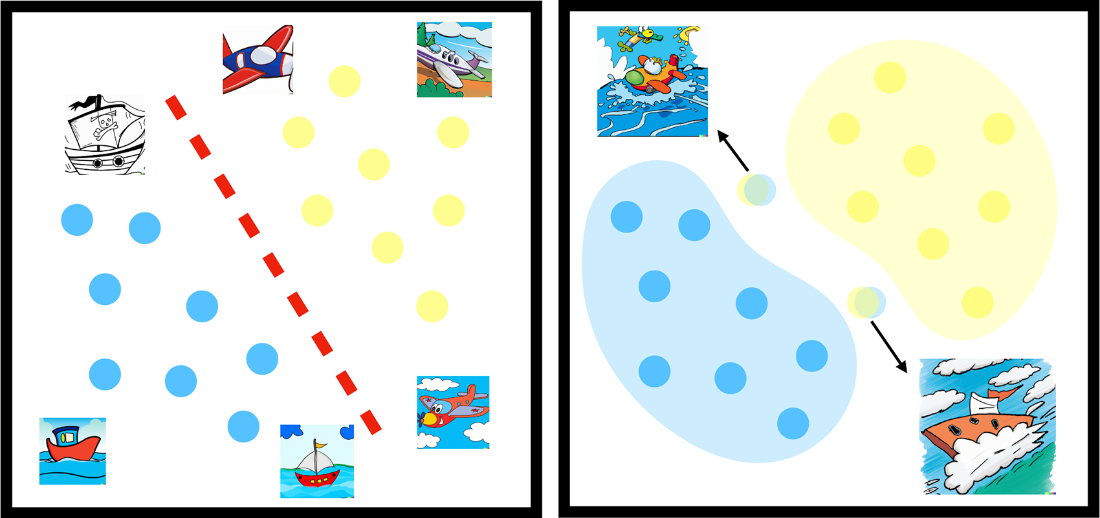
Compare a boundary separating boats from airplanes with a model of where their images lie in the dataspace. Modeling the latter can yield synthetic combinations, such as an airplane on water. section 5.1.1
In probability terms, classification asks for a target given an input, P(Y|X); generative modeling is described here as modeling the joint distribution P(X,Y). That is a larger job: recognizing a boat may require a few distinguishing features, while generating plausible images must capture more of the relationships in the data. section 5.1.1
Two practical uses are:
- Create synthetic examples when collecting or labeling data is costly, including candidate drugs or rare image conditions. Check added examples for bias and noise. section 5.1.2
- Learn low-dimensional representations without labels, then use them for tasks such as clustering or classification. section 5.1.2
For graphs, an autoencoder compresses data with an encoder and reconstructs it with a decoder; graph autoencoders commonly decode edges with a dot product. A variational graph autoencoder adds a distribution-based, regularized latent space. Use a graph autoencoder for focused reconstruction such as link prediction; favor a variational graph autoencoder when diverse synthetic graphs or subgraphs matter more. The latter can also suit noisy data, while the former is faster on clearly structured graphs. section 5.6 section 5.3.2
Choosing a graph model
To predict missing edges, train a graph autoencoder to reconstruct graph connections. To seek varied small chemical graphs for drug discovery, consider a variational graph autoencoder and its more structured latent space. section 5.3.2




























