Generative artificial intelligence uses models trained on large datasets to produce new text, images, videos, audio, code, and other content from learned patterns. Large language models interpret natural-language prompts to answer questions, converse, and perform tasks. section 8.0 section 8.1.1
A generative AI application can:
- Accept natural-language prompts to search movie descriptions through stored vector embeddings. section 8.1
- Use an LLM as a conversational movie chatbot or an agent that manages watchlists. section 8.1
- Combine Postgres, pgvector, similarity search, and retrieval-augmented generation for personalized recommendations. section 8.7
Movie recommendation prompt
A user asks, “What are the other two movies produced by the studio that made Shrek?” An LLM can interpret the request and respond with examples such as “Madagascar” and “Kung Fu Panda.” section 8.1.1
Figure 8.1 The LLM uses various tools to perform tasks following user prompts.
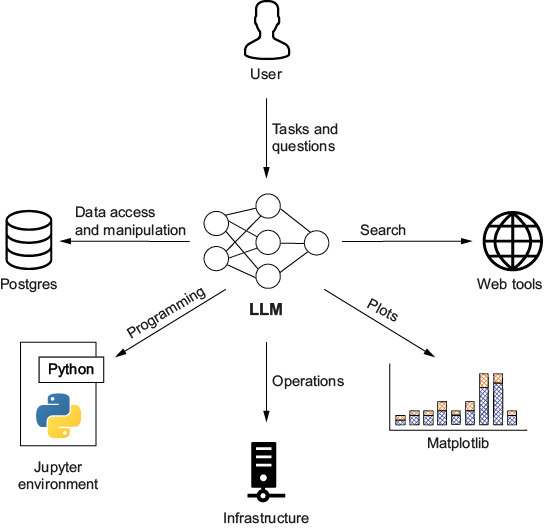
LLMs can call web tools, services, protocols, and APIs when completing prompts that require actions beyond their internal knowledge. section 8.1.1




























