Generative modeling creates new content by learning patterns or distributions from existing data. Outputs can include text, images, code, audio, music, video, and other data instances. section 1.1 section 1.5
Unlike discriminative modeling, which predicts labels or class boundaries, generative modeling learns how data is distributed and samples from that knowledge to synthesize novel instances. Statistically, it targets the joint distribution of inputs and labels, P(X, Y), rather than only the conditional probability P(Y|X). section 1.1.1 section 1.1
Common applications and model families include:
- Generate realistic images from short text prompts, as with text-to-image systems. section 1.0
- Produce essays, music, legal documents, source code, audio, and video. section 1.0 section 1.5
- Use GANs, in which a generator creates samples and a discriminator distinguishes generated data from real data. section 1.5
- Use Transformers and attention to model long-term dependencies in sequences and generate outputs one element at a time. section 1.5
Dog-and-cat images
A discriminative model classifies an image as a dog or cat from predicted label probabilities. A generative model learns defining characteristics of both classes, then uses task descriptions or latent-space values to synthesize new dog and cat images. section 1.1.1
Figure 1.1 A comparison of generative models versus discriminative models. A discriminative model (top half of the figure) takes data as inputs and produces probabilities of different labels, which we denote by Prob(dog) and Prob(cat). In contrast, a generative model (bottom half) acquires an in-depth understanding of the defining characteristics of these images to synthesize new images representing dogs and cats.
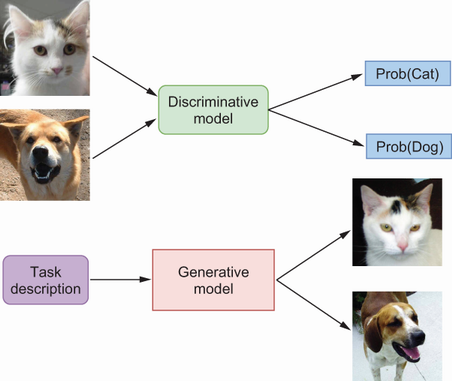
Compare classification outputs with synthesized image outputs in the generative-versus-discriminative model diagram. section 1.1.1




























