A spam filter answers a yes-or-no question, and a house-price model produces a number. Generative modeling tackles the harder creative task: producing new text, images, music, or other data that resembles examples it has seen. section 1.13
Generative models learn how a dataset looks well enough to create new data points from that pattern. They belong to unsupervised learning because they can learn from existing data without relying on labels. section 2.10 section 2.14
From face dataset to new faces
Give a model many face images. Rather than classifying whether an image contains a face, it learns the visual structure of those examples and produces realistic-looking faces that were not in the dataset. Similar systems can generate paintings, videos, music, stories, and poetry. section 2.14
Important families include:
- Generative adversarial networks (GANs), variational autoencoders, and restricted Boltzmann machines (RBMs). section 2.14
- Generative modeling is harder than classification because creating a convincing example requires learning much more about the data. section 1.13 section 2.14
Figure 1.10 Predictive machine learning is akin to answering questions, such as multiple choice. Generative learning is akin to writing an essay or drawing an image.
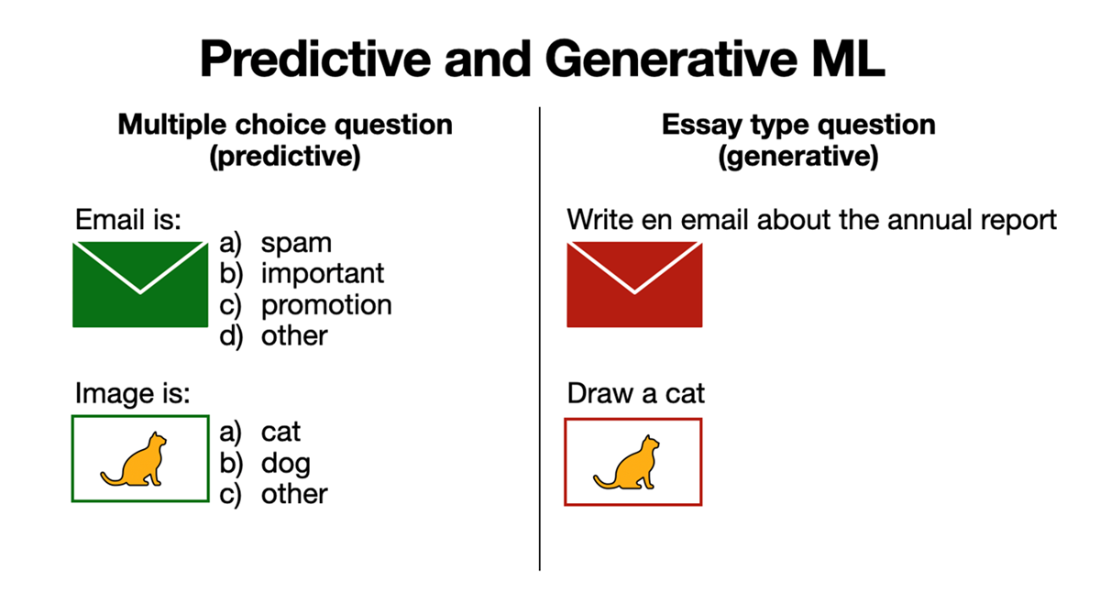
Compare predictive learning with generative learning through the contrast between answering a multiple-choice question and writing an essay or drawing an image. section 1.13































