A prompt is an instruction or input supplied to an AI model. For codebase work, replace vague requests such as “Explain this code” with commands that force answers you can check. section 1.3.1 section 2.0
The useful mental model is constraint over prose: request a traceable diagram, a number, a named story, or a worked example instead of adjectives and generalities. section 2.3 section 2.6
Sharpen a prompt by demanding one of three concrete forms:
- Ask for a story: trace one real request or user journey from beginning to end. section 2.3
- Ask for numbers: require measurements or counts instead of descriptive adjectives. section 2.3
- Ask for a toy example: make the model demonstrate an abstract claim with checkable inputs and outputs. section 2.3
From generic answer to checkable artifact
Weak: “What does this project do?” Better: “Explain what this does in one sentence, like a Y Combinator application.” Weak: “What happens when a user creates an order?” Better: “Generate a Mermaid sequence diagram for POST /api/orders.” Weak: “Is this database schema good?” Better: “The users table stores preferences in JSONB. Give one alternative and its trade-off.” section 1.3.1 section 1.3.1 section 1.3.1
Figure 1.3 Three panels, each showing a coder accepting fluff and an engineer issuing a command that forces a checkable answer: a one-sentence YC-style summary, a Mermaid diagram, and an alternative-with-trade-off.
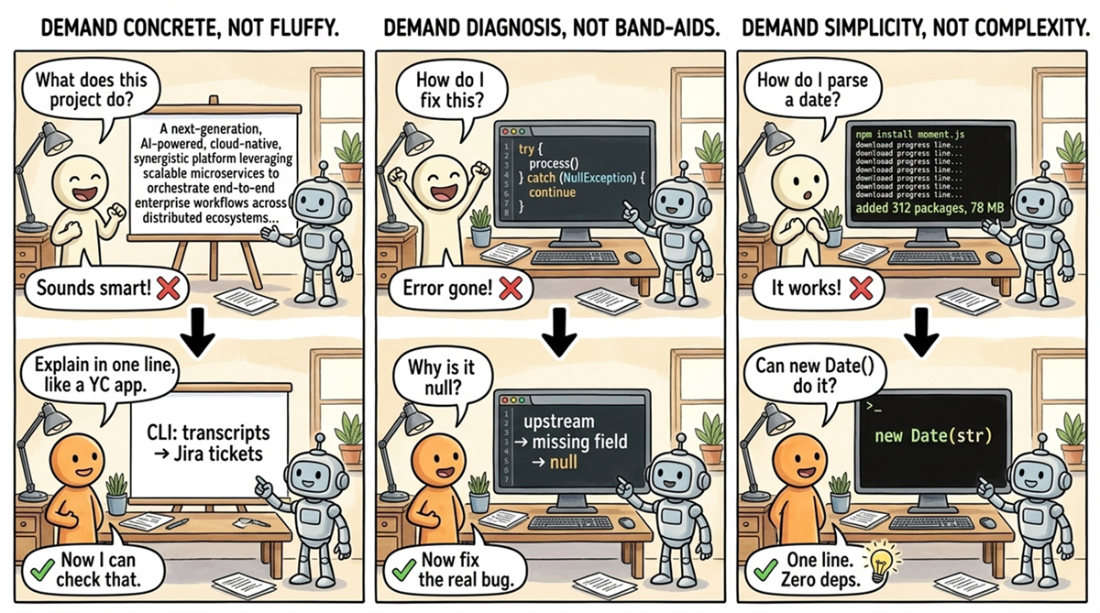
Compare vague answers with commands requiring a one-sentence summary, a Mermaid diagram, or an alternative with trade-offs. section 1.3.1
Use a single file, ask one initial question, then follow up on the surprising line. Select only relevant code, document the answer immediately, and treat chat as a first learning pass rather than a scalable repository workflow. section 2.6