A prompt is the instruction and context supplied to an artificial system to guide its response. For a language model, it connects user intent to generation: it can pose a question, assign a role, specify a format, or frame an objective. section 6.3.1
The prompt can contain more than the immediate request. Depending on the surrounding system, it may include system instructions, examples, earlier conversation turns, retrieved documents, and tokens already generated. These provide the active context for the task, while the model’s parameters supply patterns learned during training. section 6.4.1 section 6.4.2
A language model does not follow a prompt by executing commands against a rule engine. It generates a continuation conditioned on the input and learned patterns. Apparent compliance is therefore not a guarantee: ambiguous or conflicting cues can produce responses that fail to respect a requested constraint. section 6.3.1
Figure 6.6 Language generation as probabilistic continuation. Given a prompt, the model produces a probability distribution over possible next tokens based on patterns learned during training. The response emerges by selecting tokens from this distribution step by step, rather than by executing explicit rules.
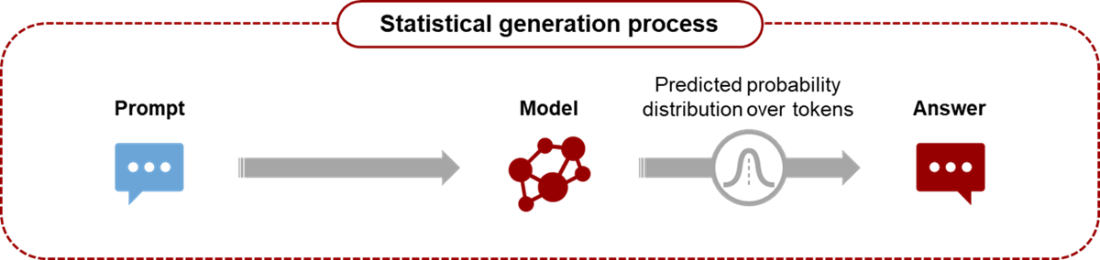
The figure shows how a prompt conditions step-by-step token generation rather than triggering explicit rule execution. section 6.3.1
Wording, tone, layout, and example order can alter a response even when the task remains the same. The size of this sensitivity depends on the model and on how performance is measured. Refining a prompt by intuition alone is unreliable: without correct answers or another objective reference, an apparently better response may conceal worse performance. section 6.3.2 section 6.3.3
Revising a prompt without answers
In a classification exercise, participants repeatedly revised prompts without seeing the correct answers. Many believed their changes improved performance when they did not; in some cases, accuracy declined. The example illustrates why response quality should be checked against independent evidence rather than judged solely by how convincing an output appears. section 6.3.3
A prompt is also limited by the context window, measured in tokens. Relevant material outside the active input cannot shape the next prediction unless it is included or already reflected in the model’s parameters. A surrounding system may have to omit, truncate, or compress material to fit. section 6.4.1 section 6.4.2
Retrieval-augmented generation addresses this limit by selecting passages from an external knowledge source and inserting their text into the prompt alongside the question. This can ground responses in identifiable information, but it does not guarantee correctness or eliminate hallucinations. section 6.4.4 section 6.5