A system prompt supplies standing instructions for an assistant. Like other prompts, it guides a model’s response without retraining the model. It differs from a user prompt, which supplies the specific query for an interaction. section 1.1.1 section 6.1.1
In retrieval-augmented generation (RAG), the assistant responds using three inputs: standing instructions, the user’s query, and in-context knowledge retrieved from external sources. Retrieved knowledge supplies information; it is distinct from the instructions and the query. section 6.1.1
Figure 6.4 The generalized RAG framework. The system prompt provides standing instructions. The user prompt provides the query. In-context knowledge, retrieved from external sources, populates the context window. The assistant response is produced from all three inputs combined.
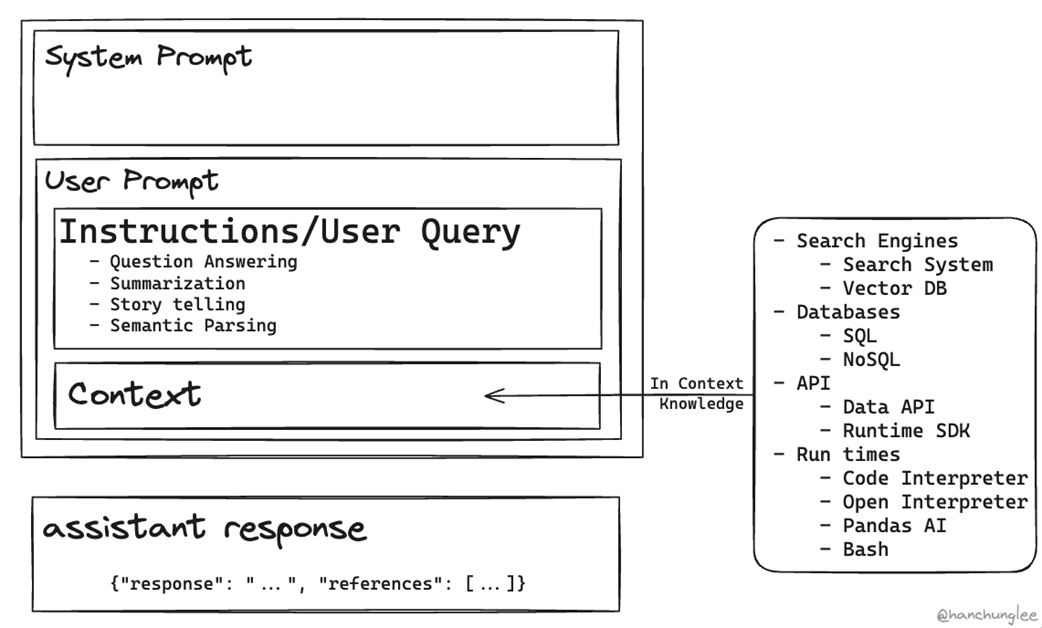
The diagram shows how the system prompt, user prompt, and retrieved knowledge combine to produce a RAG response. section 6.1.1
The name and authority of standing instructions depend on the platform. Under OpenAI’s 2025 Model Spec, system rules are set by the platform and cannot be overridden by developers or users; developers customize behavior through a developer prompt within those limits. OpenAI formerly used the term system prompt for developer-set behavior, while Anthropic calls its API input a system prompt. section 8.4.2
Separating RAG inputs
For a question answered using retrieved documents, identify the standing assistant instructions as the system prompt, the question as the user prompt, and the documents as in-context knowledge. Evaluate whether the documents are relevant to the query and whether the answer is faithful to them as separate checks. section 6.1.1 section 6.1.2