Continuous improvement is the feedback loop between recommendations and user behavior. A system shows items, users interact with them, and those interactions are logged as data for future recommendations. Repeating the cycle lets recommendations adapt over time; it does not guarantee that they improve for every user or item. section 1.3 section 1.6
Figure 1.6 The recommender system feedback loop. Users receive recommendations, interact with content (clicks, purchases, views), interactions are logged, this data trains models, and improved models generate better recommendations.
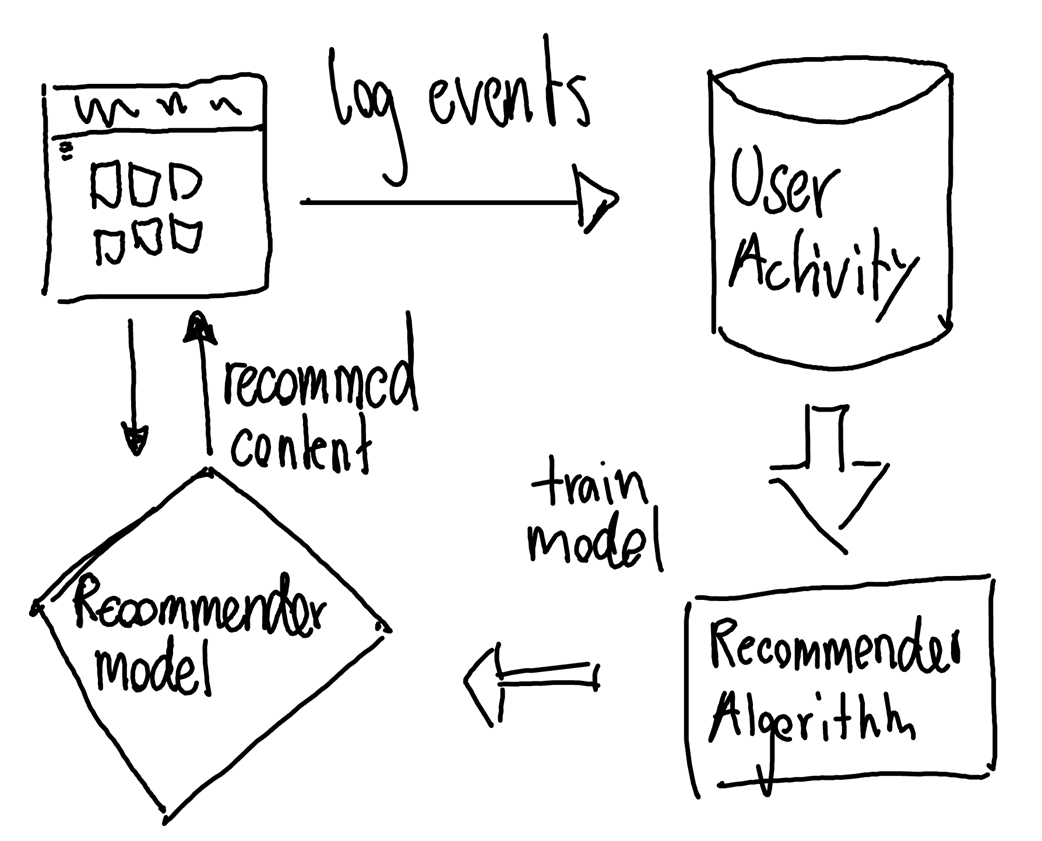
The diagram traces the production cycle from recommendations through user interactions and logging to model training and subsequent recommendations. section 1.3
The logged signal needs interpretation:
- Implicit feedback, such as clicks, purchases, watch time, and skips, is plentiful but noisy: a click does not necessarily mean the user liked an item. section 1.3
- Explicit feedback, such as ratings, reviews, and thumbs-up or thumbs-down, has a clearer meaning but is sparse. It can sharpen the behavioral signal when available. section 1.3
- Behavioral data can reveal shared tastes that item metadata misses, making the loop useful for collaborative filtering. section 1.3.2
When more interaction data reinforces a bias
If a popular comic such as Asterix is recommended often, it can collect more interactions and appear still more popular in later training data. A niche title such as Little Frog may struggle for visibility. Repeated similar recommendations can also narrow what users discover. New users and items present the opposite problem: they have little interaction history to feed back. The system must balance showing items it expects users to like with trying less-certain items. section 1.3.2 section 1.6