Continuous improvement can arise through a feedback loop: a system’s outputs or effects influence later inputs, changing subsequent behavior. Repeated cycles can reinforce useful capabilities, but they can also amplify harmful patterns. The direction of change depends on what is measured and fed back into the system. section 4.4.2 section 7.3.5
In a mixture-of-experts model, a gating network selects experts for each token. Selected experts receive a learning signal; unselected experts do not receive that token’s direct expert update. An expert repeatedly assigned a type of pattern can improve at it, making the gate more likely to select it for similar tokens. Specialization emerges through repeated assignment and reinforcement rather than explicit labels. section 4.4.2
This loop needs balance. If routing concentrates too heavily on a few experts, others receive too little data to learn useful behavior. If routing is too even, experts encounter mixed patterns and specialization weakens. section 4.4.2
When feedback reinforces bias
A predictive policing system trained on past policing data may direct more attention to neighborhoods already subject to heavy policing. More surveillance produces more recorded incidents there, which can appear to confirm the original prediction and reinforce the cycle. section 7.3.5
AI development can also feed improvements into later AI systems. Automated machine learning uses algorithms to tune hyperparameters, select features, and compare configurations; neural architecture search extends this approach to network structures. These techniques optimize parts of development without making AI research autonomous. section 8.4.4
AI-assisted AI development
AlphaEvolve uses language models in an evolutionary coding process to generate and modify programs that are evaluated automatically. Its reported improvements include parts of data center operations, chip design, and AI training processes, including components related to training its underlying models. section 8.4.4
Figure 8.8 AI-assisted improvement of AI. AI can help improve future AI by contributing to better model architectures, software, computational primitives, and specialized hardware, creating a feedback loop in which research advances are fed back into later systems.
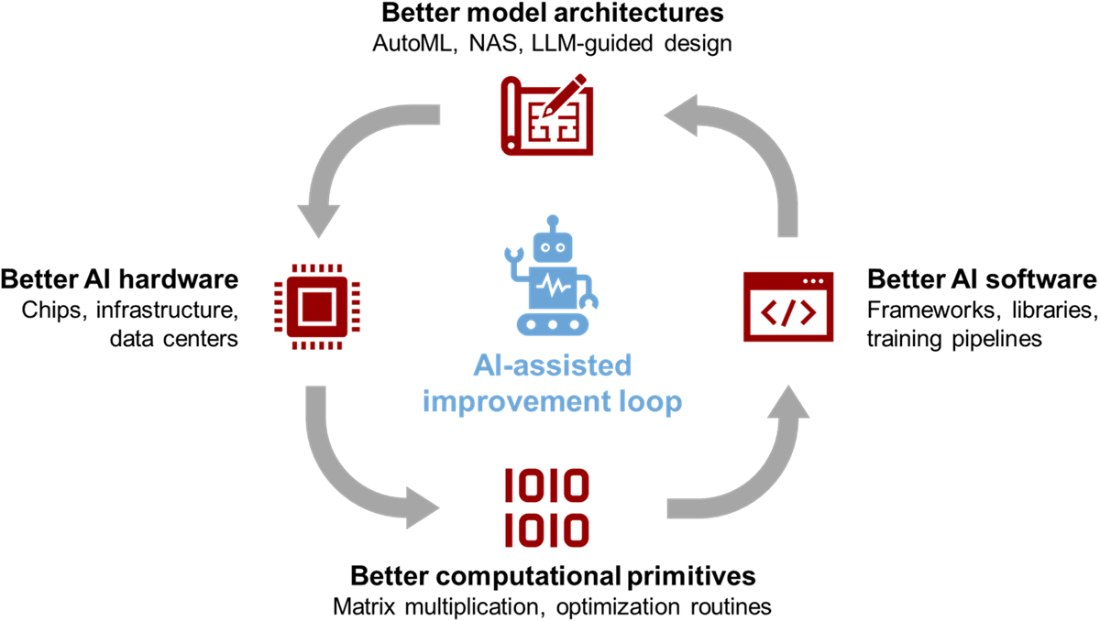
Trace how improvements to architectures, software, computational primitives, and hardware can feed into later AI systems. section 8.4.4