Architecture does not end at design approval. A feedback loop connects intent, the forces shaping a decision, its consequences, and the adaptation that follows. It treats late-emerging cost, fragility, loss of clarity, and reduced flexibility as evidence that assumptions may need revision rather than as isolated failures. section 1.1
The loop is valuable because architectural consequences often arrive after change has become expensive. Requirements, team capability, legacy dependencies, technical debt, operational maturity, and organizational structure constrain what is feasible; feedback makes the effects of choices visible so teams can decide which trade-offs remain acceptable. section 1.1 section 4.10
Use feedback as a sensing and decision system:
- Watch for friction, workarounds, recurring rewrite discussions, incidents, rising coordination, and hesitation around fragile modules or integrations. section 4.3
- Make signals explicit through observability, architectural reviews, decision records, and regular dialogue with teams. section 4.3
- Choose deferral, adaptation, or replacement according to context, then observe costs, incidents, and team pain created by that choice. section 4.3
- Preserve room to learn by delaying irreversible decisions and using seams, stable contracts, backward compatibility, and incremental replacement. section 4.10
Start with visible pain
A useful first loop can focus on one recurring problem: a module nobody wants to touch, an integration that repeatedly breaks, or repeated production incidents. Gather evidence with the affected team, identify whether boundaries, dependencies, tests, or ownership are contributing, and make a deliberate next decision before the pattern hardens into rigidity. section 4.3 section 4.3
Figure 4.1 Evolutionary architecture depends on feedback loops that make change visible and allow systems to adapt before rigidity turns into failure.
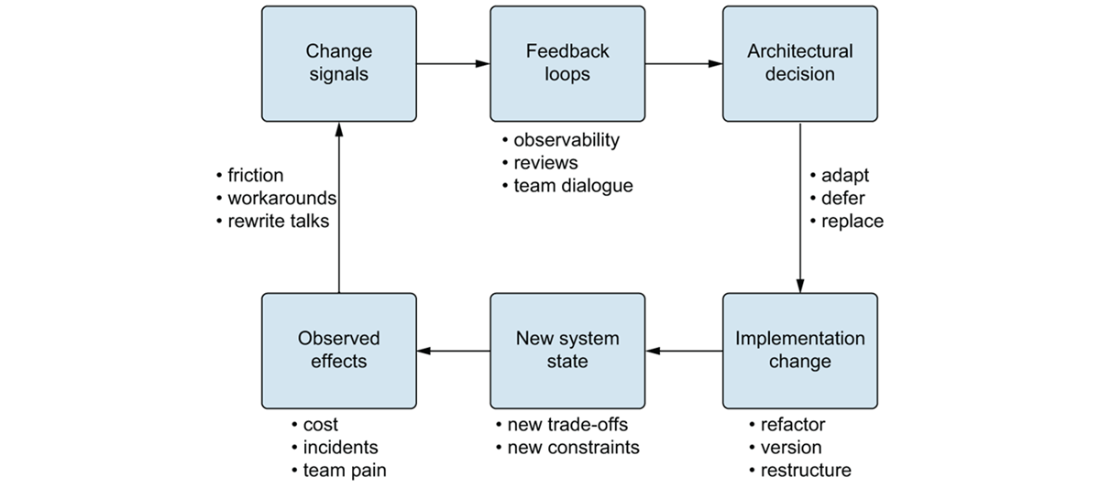
This model traces how change signals become explicit feedback, support a decision, and produce new effects that feed the next cycle. section 4.3