Continuous improvement turns production interactions into evidence for system changes. The serving path returns a response first; afterward, completed traces can be scored and their results used to guide systematic improvement. section 7.7 section 8.5
A repeatable improvement cycle connects production behavior to controlled changes:
- Collect production traces and attach quality signals from automated, LLM-based, or human scoring. section 8.0
- Move low-scoring or edge-case traces into evaluation datasets, then compare candidate changes offline. section 8.0
- Test promising variants in production with A/B testing, then use the results to inform the next cycle. section 8.0
Figure 8.5 Asynchronous scoring and experiment feedback loop for a patient intake request. After the response is returned, scoring rules evaluate the completed trace and record results. If an A/B test is active, the experimentation service associates those outcomes with the assigned variant to support comparison and improvement.
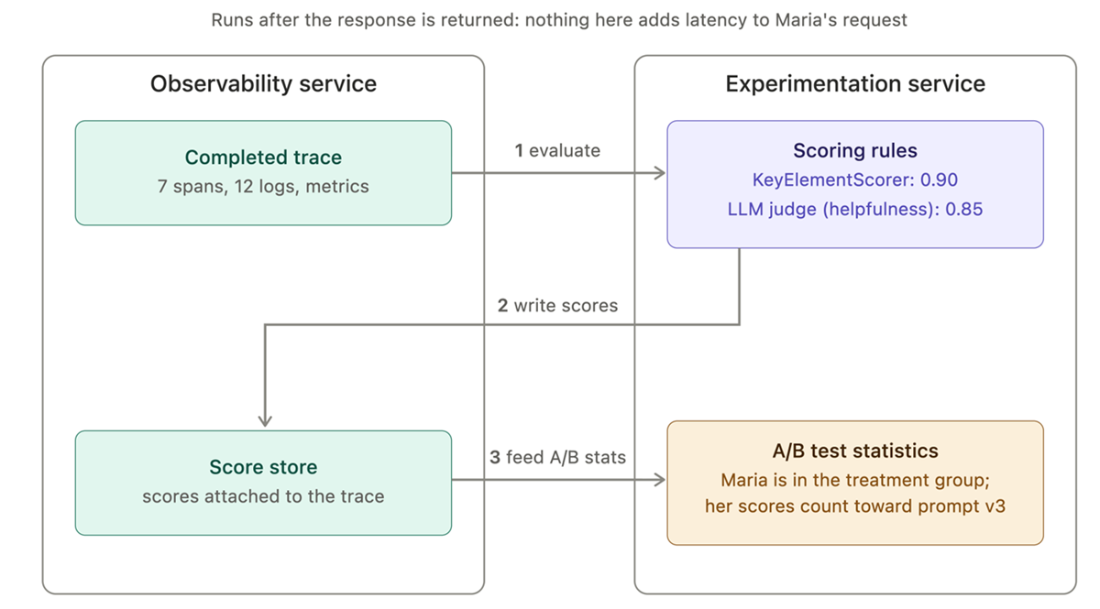
The asynchronous path scores a completed patient-intake trace after the response is returned, records the result, and associates it with an experiment variant when applicable. section 8.5