Artificial intelligence (AI) uses computational methods to simulate capabilities associated with human intelligence, including learning, problem-solving, pattern recognition, prediction, and action. Machine learning (ML) is a subfield of AI that learns from data without explicit programming; deep learning is a further ML subset using artificial neural networks. section 22.3 section 22.3.1
Distinguish the main learning and AI categories:
- Supervised learning trains on labeled data to learn relationships between inputs and known labels. section 22.3.1
- Unsupervised learning analyzes unlabeled data, identifying patterns and grouping items into clusters that humans may later interpret. section 22.3.1
- Reinforcement learning improves through interaction with an environment and positive or negative feedback. section 22.3.1
- Predictive AI uses historical data to forecast future events, while generative AI creates new content resembling learned data. section 22.3.2
In network operations, AI and ML process historical and real-time data to uncover patterns, anomalies, and insights. They support performance improvement, security enhancement, and routine-task automation while networks become larger and more complex. section 22.3.3 section 22.0
Apply predictive AI to network planning and operations:
- Forecast traffic and provision resources or adjust QoS policies before anticipated load increases. section 22.3.3
- Identify likely hardware failures early to schedule maintenance and reduce downtime. section 22.3.3
- Analyze traffic, user behavior, and security history for capacity planning and threat prediction. section 22.3.3
Learning from images
A supervised model learns from cat and dog images labeled accordingly. An unsupervised model receives unlabeled images, groups them by visual patterns, and leaves humans to interpret the clusters. section 22.3.1
Figure 22.10 Machine learning is a subfield of artificial intelligence. Deep learning is a further subset of machine learning using artificial neural networks.
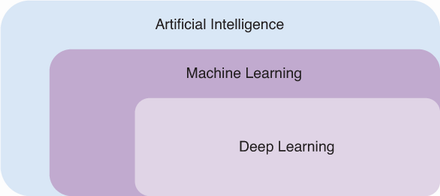
Use the hierarchy diagram to relate artificial intelligence, machine learning, and deep learning. section 22.3.1






















