Artificial intelligence (AI) assists code reviews by providing an initial, repeatable inspection of pull requests (PRs). It can summarize changes, suggest improvements, explain feedback, detect code smells, and answer questions while human reviewers retain final responsibility. section 13.1 section 13.6
Use AI as a first pass to:
- Speed feedback by analyzing a PR when it opens and returning suggestions or explanations in near real time. section 13.1.1
- Catch lower-stakes problems, including syntax errors, anti-patterns, design issues, and code smells, before human reviewers focus on architecture and project alignment. section 13.1.2
- Apply configured checks consistently across contributors and PRs, supporting larger teams and codebases. section 13.1.3 section 13.1.4
- Validate every finding rather than accepting it automatically: AI may miss rare cases, misread domain context, hallucinate problems, or produce incorrect fixes. section 13.2.1 section 13.2.2
- Continue independent human review so architectural fit, maintainability, readability, project goals, and team knowledge remain visible. section 13.2.3 section 13.5
A practical review sequence
When a PR opens, an AI reviewer can inspect snippets for syntax errors, anti-patterns, and design problems, then explain suggested changes. A developer checks each result, corrects genuine issues, and performs an independent review before deciding whether to merge. This avoids treating an incorrect security warning or hallucinated fix as authoritative. section 13.1.1 section 13.2.1 section 13.2.2
Figure 13.8 The future of code reviews relies on a balance between human and AI responsibility.
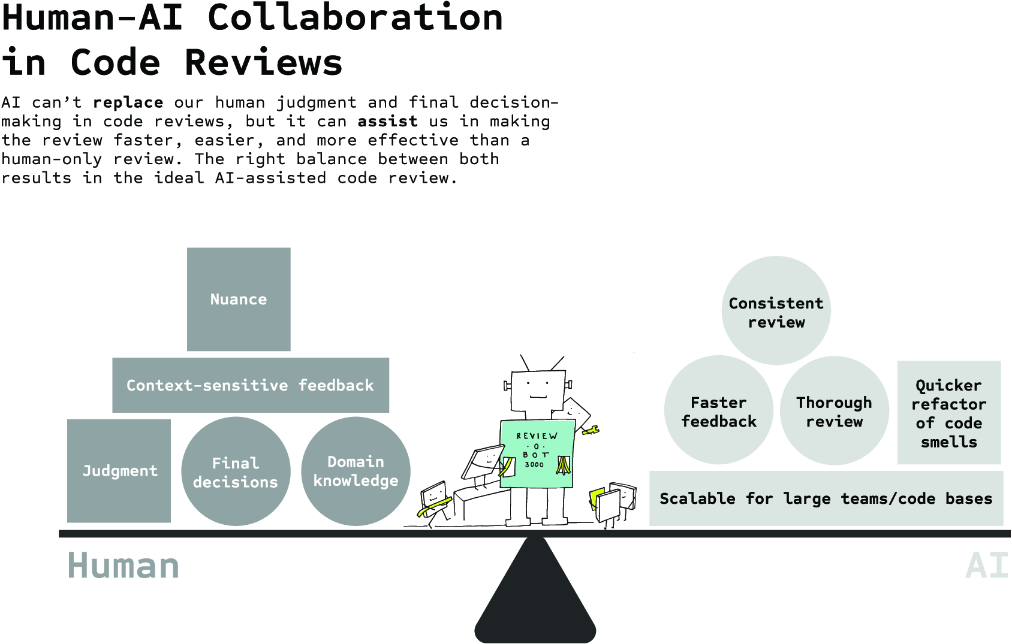
Use the balance between human responsibility and AI assistance as a decision guide for adopting AI in code reviews. section 13.5






















