Artificial intelligence (AI) creates machines and solutions that mimic human intelligence. It extends machine learning beyond statistical and mathematical models toward capabilities such as reasoning, perception, language use, learning, prediction, and decision-making. section 10.1 section 1.3
AI connects technical modeling with practical business and societal applications:
- Begin with a defined business problem, then prepare data through mining, engineering, transformation, cleaning, and loading before analysis and modeling. section 1.3
- Use data-driven algorithms, including neural networks and deep learning, rather than relying only on explicitly encoded rules. section 10.1
- Apply AI across finance, retail, aviation, life sciences, manufacturing, customer service, education, and research to improve decisions, efficiency, and communication. section 10.1 section 10.7
From pattern recognition to generation
AI systems support self-driving cars, conversational chatbots, speech-to-text conversion, translation, essay grading, photo captioning, and prompt-based generation of images, videos, and text. Generative models learn data distributions to create new, similar data points, while discriminative models classify data. section 1.3 section 10.9
Figure 1.7 How the various fields are interlinked with each other and how they are dependent on each other
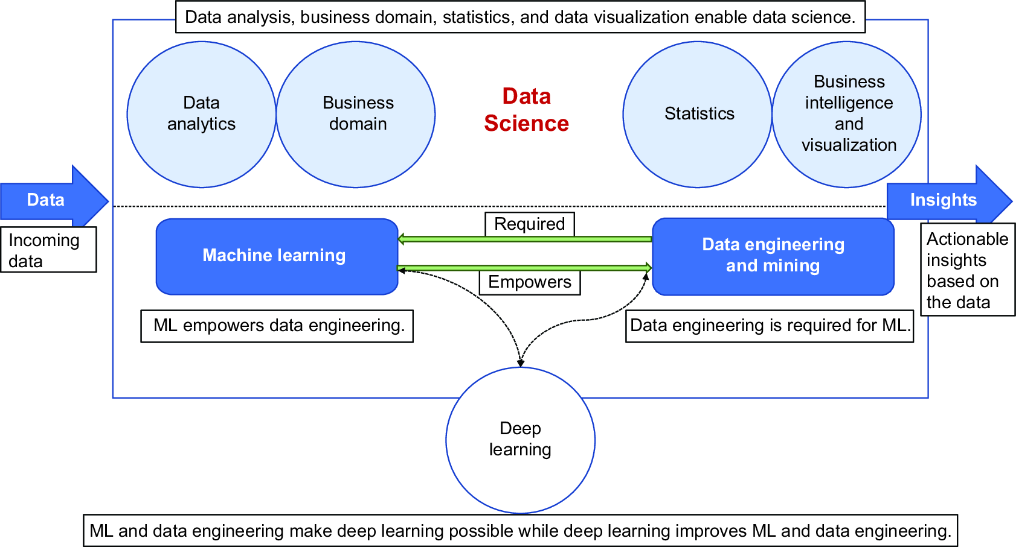
Use the field relationship diagram to navigate how data engineering, analytics, data science, machine learning, business intelligence, visualization, and AI depend on one another. section 1.3






















