Artificial intelligence (AI) is the broad effort to automate intellectual or cognitive tasks normally performed by humans. It began as a research field in the 1950s and includes approaches that learn from data as well as approaches based on explicit rules. section 1.2 section 20.1.1
Keep the field hierarchy clear:
- Machine learning develops programs from training data rather than having programmers specify every rule. section 20.1.1
- Deep learning is a branch of machine learning built from layered geometric transformations whose weights are learned during training. section 20.1.1
- Symbolic AI uses explicit rules and knowledge representations; early chess programs are a practical example. section 1.2
- Generative AI is a deep-learning subset that generates text, images, video, or sound. section 20.1.1
AI in practice
AI applications range from simple automation, such as an Excel spreadsheet, to sophisticated systems such as chatbots, AI companions, autonomous driving, protein-structure prediction, and scientific assistance. section 1.12 section 20.1.1
Figure 1.1 Artificial intelligence, machine learning, and deep learning
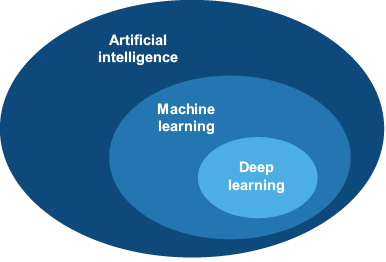
Use the relationship diagram to distinguish the broad AI field from its machine-learning and deep-learning subsets. section 1.1