Artificial intelligence (AI) uses computational methods to perform tasks associated with human intelligence, including reasoning, prediction, and language understanding. In digital products, it can refine marketing, automate routine support, enable smart search, power agentic chatbots, or underpin entirely new services. section 1.0
AI changes product work because outputs are probabilistic rather than fully predictable. Useful systems therefore combine suitable data and intelligence with guided user experiences, governance, transparent limitations, safeguards, and continuous evaluation. section 1.5
A practical AI product approach:
- Start with a real customer need or strategic business goal rather than adopting AI for its own sake. section 2.0
- Assess potential value, technical feasibility, organizational context, and the balance between quick wins and long-term goals. section 2.0
- Prototype, test, and iterate with user feedback; communicate capabilities and limitations without overpromising. section 1.5
- Address privacy, bias, fairness, errors, adoption, and cross-functional alignment alongside model performance. section 1.5
From feature pressure to useful opportunity
A team pressured to build a chatbot should first identify the customer task it will improve, compare its value and feasibility with other opportunities, and define how feedback will guide iteration. Without a clear use case, the chatbot may frustrate users instead of improving service. section 2.0
Figure 2.1 This chapter addresses discovery in the opportunity space in the mental model of an AI system.
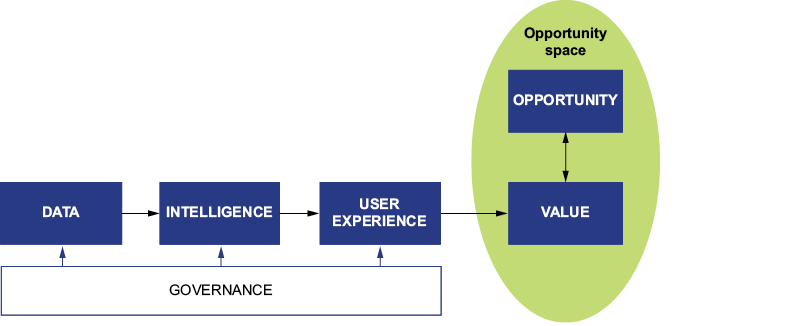
Use the opportunity-space view to connect AI discovery with the wider system of data, intelligence, user experience, and governance. section 2.0