Performance measures how quickly a system responds and how much work it handles. Faster responses can improve the user experience, but performance has a price: tighter targets require more investment. section 2.4
Two useful ways to describe performance are:
- Latency: how long a request takes to receive a response. section 2.4
- Throughput: how much work the system completes per unit of time. section 2.4
Speeding up a dashboard
A dashboard that runs three slow database queries for every request can create 300 queries when 100 users visit at once. Add a cache: check it first, and, on a miss, run the queries and store the result. Later requests can return the saved summary quickly. The tradeoff is extra complexity and data that may not be fully up to date. section 2.4.4
Figure 2.8 By checking a fast cache first, the system avoids expensive database queries. A Cache Miss creates a temporary delay to fetch and save data, but each subsequent request becomes nearly instantaneous.
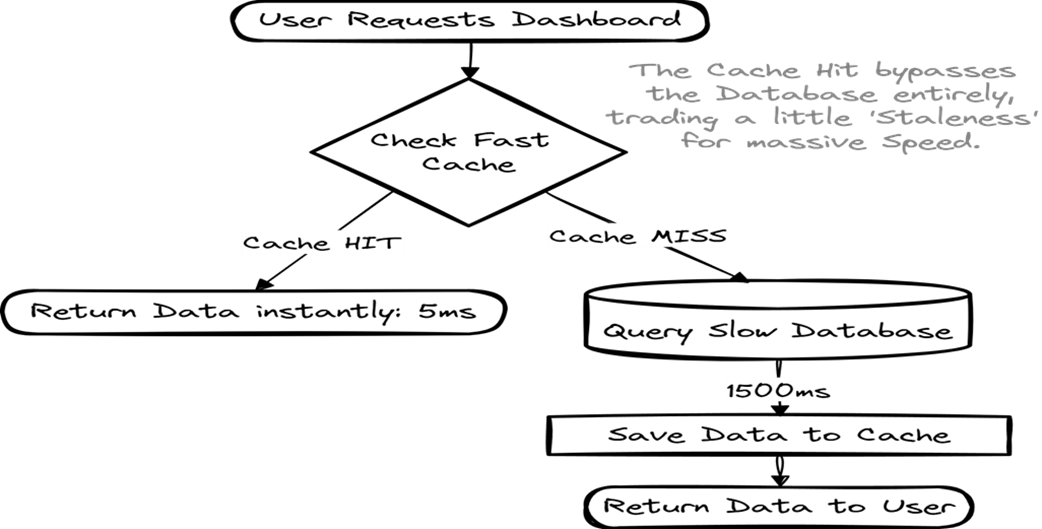
Shows how a cache hit avoids database queries, while a cache miss requires fetching and saving the data. section 2.4.4
Performance is a quality to balance, not a goal to maximize blindly. A social platform might favor fast page loads over perfectly up-to-date connections; the right priority depends on the business and user experience. section 1.7.3