Performance is the observable execution or result of a task. In language models, it can mean producing coherent, contextually appropriate text that meets a task’s demands. A useful result does not, by itself, establish how the system produced it or whether it understands the result. section 2.1.2 section 9.1.4
Performance differs from competence: the latter is the underlying capacity that makes performance reliable across cases. Memorizing one answer is not the same as mastering a subject. Flexible, repeatable performance under changing conditions provides stronger evidence of competence, although it may not settle what kind of capacity is involved. section 9.1.4
Evaluating performance requires criteria suited to the task. No single score captures every aspect of language quality: fluent writing can be factually wrong, and a response can stay on topic while losing coherence. A benchmark gain may therefore conceal weaknesses in other dimensions. section 2.6.6
Different tasks call for different judgments:
- Translation must balance faithfulness and natural phrasing; summarization must condense without distortion. section 2.6.6
- Dialogue calls for relevance, tone, and safety; classification calls for precision and interpretability. section 2.6.6
The measure used in training is not necessarily the quality needed in an application. Predicting the next token rewards plausible continuation, but does not require verification against external facts. Evaluation and fine-tuning can also favor attempting an answer over refusing under uncertainty, encouraging confident but unsupported responses. section 6.1.2
Figure 6.1 Models learn patterns from training data and extend them to new cases. In this example, animals associated with water are often labeled as fish. When no clear example is available, as with the dolphin, the model does not stop or admit uncertainty. It continues by extending the strongest available pattern, incorrectly classifying the dolphin as a fish rather than a mammal.
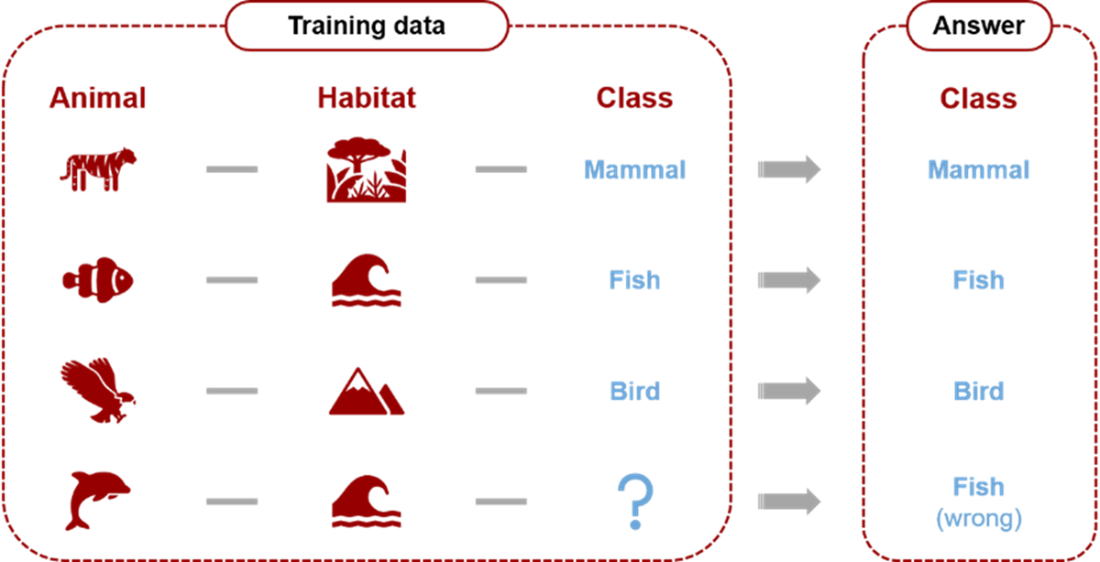
The animal-classification example illustrates how extending a learned pattern can produce a plausible but incorrect result. section 6.1.2
Performance also depends on the balance of model size, training data, and computation. Larger models trained on more data tend to make fewer errors, but additional increases yield diminishing gains. Broad, diverse exposure helps models learn which regularities hold across domains and which depend on context. section 4.2.2
A copyist’s performance
A master copyist may produce a painting visually indistinguishable from an original. If visual appearance is the criterion, the results may be equivalent; if originality, authorship, intention, or context matter, they can represent different achievements. Likewise, observable behavior can be valuable without settling whether a system’s activity amounts to understanding. section 9.1.4