Monitoring is the ongoing observation of deployed system behavior. It helps detect emerging failures and track whether unequal patterns appear, disappear, or worsen as systems are used. section 6.3.5 section 7.4.3
Behavior may change when a model is connected to retrieval, tools, user feedback, or new workflows, or when the model, data, or application is updated. Monitoring supports recurring review and adjustment, but cannot eliminate variability; reliability also depends on the surrounding system. section 6.3.5 section 7.4.3
Figure 7.7 Techniques for exposing bias. Bias testing compares original and modified inputs to check whether small changes produce unjustified differences in output. Subgroup evaluation compares outcomes across relevant groups or contexts to detect disparities hidden by average performance. Benchmark evaluation uses standardized test sets to measure known failure patterns, while still requiring caution because benchmarks only reveal the behaviors they are designed to test.
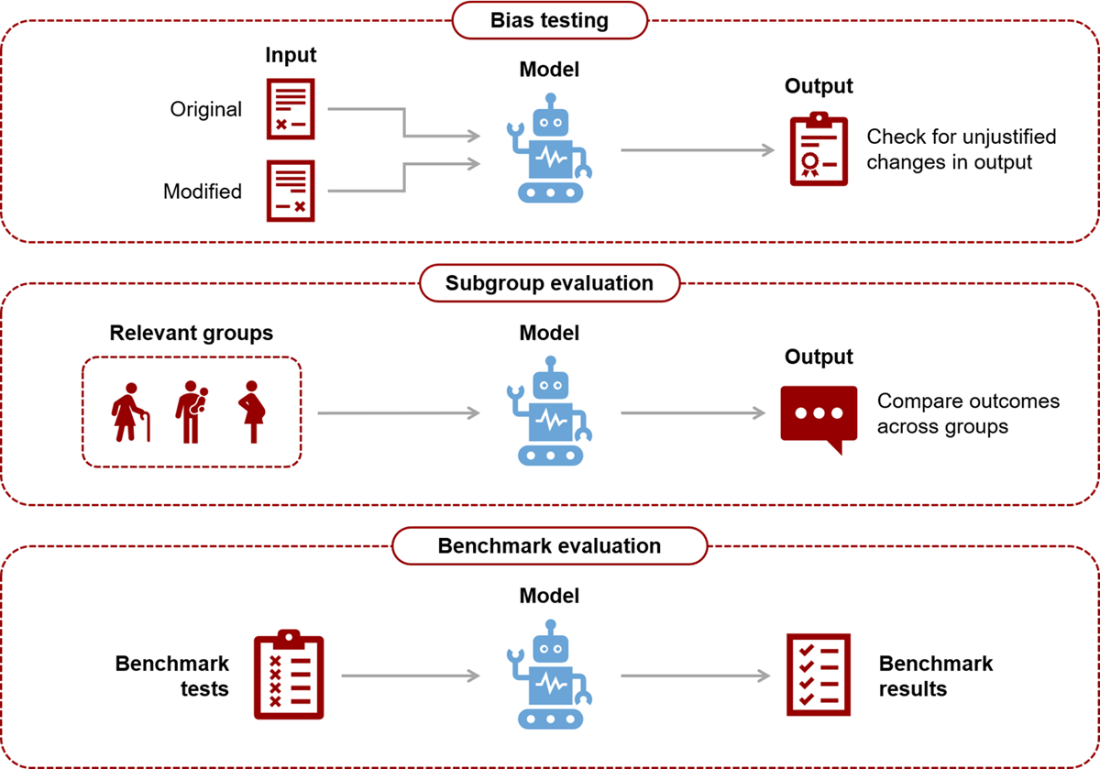
Bias testing, subgroup evaluation, and benchmarks offer ways to examine behavior, though each reveals only the patterns it is designed to test. section 7.4.3


















































