liveBook · Manning

Artificial intelligence

As explained in Build AI Drug Discovery Pipelines

Artificial intelligence is the field of computational methods for performing tasks that ordinarily require aspects of human intelligence, such as learning and reasoning.

Artificial intelligence (AI) is a broad field of computational methods for tasks associated with human intelligence. In drug discovery, it provides the wider context for machine learning methods that identify effective molecules from examples. section 1.2.2

The relationship among the main terms is:

  • AI includes methods such as decision trees, flocking algorithms, and A* graph traversal. section 1.2.2
  • Machine learning is a subfield of AI that learns from collections of examples. section 1.2.2
  • Deep learning is presented as a related category alongside AI and machine learning. section 1.2.2

From recognizing dogs to recognizing drug molecules

Training resembles teaching a child with labeled dog photographs: the model studies training instances, receives feedback, builds an internal pattern, and is tested on unseen examples. The analogous drug-discovery task is learning to recognize effective molecules. section 1.2.2

Figure 1.4 Artificial intelligence, ML, and deep learning are all related to each other.
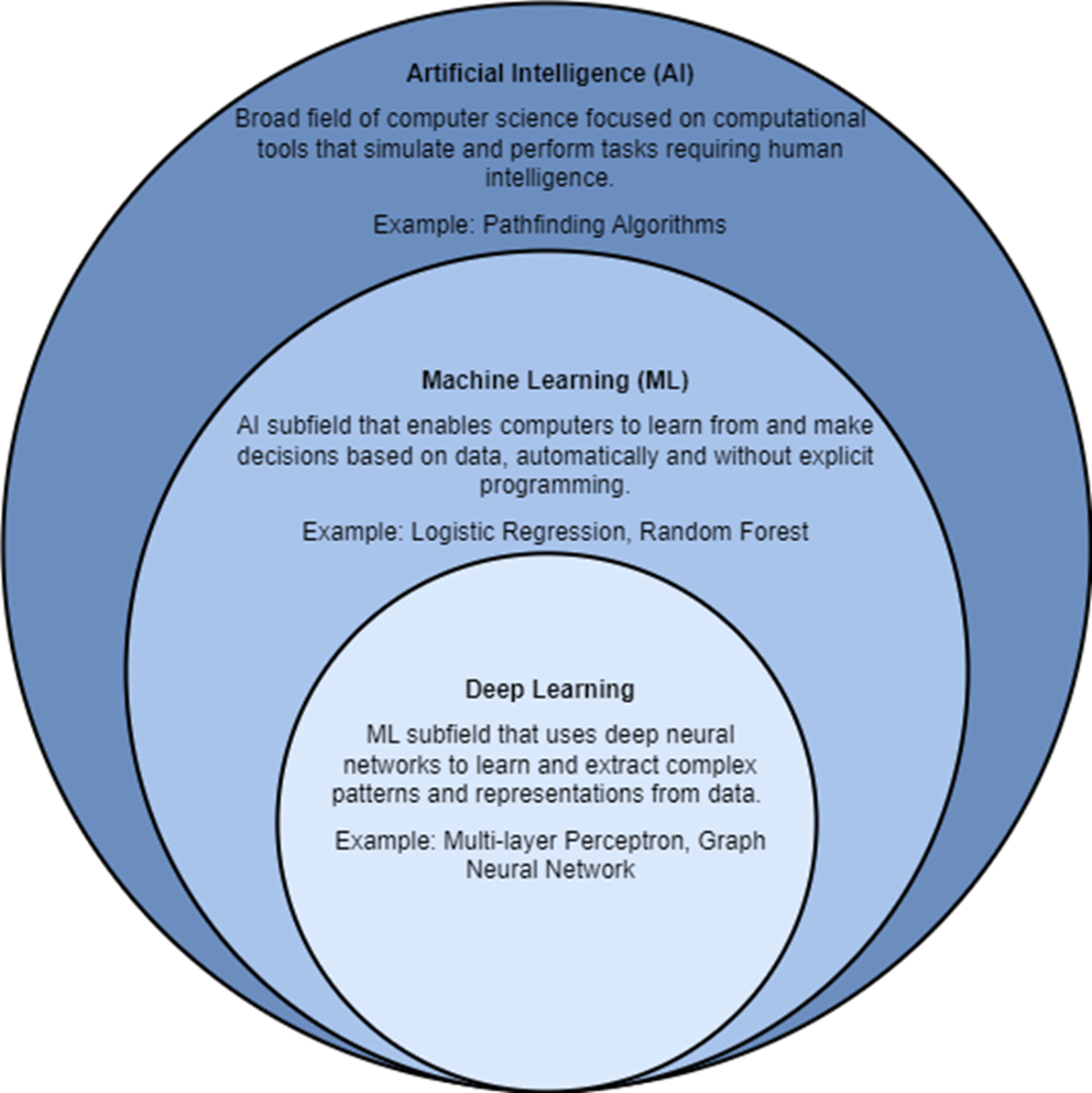
Shows how artificial intelligence, machine learning, and deep learning are related. section 1.2.2


How Build AI Drug Discovery Pipelines covers it

How deep it goes
Defines AI and machine learning, distinguishes related categories, and illustrates training and testing without supplying implementation details.
Examples
Uses decision trees, flocking algorithms, A* path-finding, dog photographs, and effective drug molecules as examples.
What it assumes
Assumes familiarity with molecular representations while introducing AI, machine learning, and deep learning terminology.
What you can do after
Evaluate/understand how AI, machine learning, and deep learning relate and how example-based training supports drug-molecule recognition.
How it connects
Connects artificial intelligence with machine learning, deep learning, training sets, training instances, and model evaluation.

Also explained in

Compare how 29 books explain artificial intelligence →

Related concepts

This explainer was generated by Manning's knowledge graph from the text of Build AI Drug Discovery Pipelines. The section links point to the parts of the book it draws on.