Artificial intelligence (AI) is the field of developing computational systems for tasks associated with human intelligence. Its systems recognize patterns, optimize decisions, play strategic games, and generate language. Such achievements demonstrate capabilities, but they do not by themselves establish human-like understanding. section 1.0 section 9.0
AI brings together several perspectives. Computer science builds algorithms and learning systems; philosophy asks what it means to reason and understand; cognitive science and neuroscience study natural minds; and business turns capabilities into applications and decisions. Interpreting AI requires attention to both what a system does and how it produces its behavior. section 1.1.1 section 5.0
AI has developed through changing approaches rather than a steady progression toward a single definition of intelligence. Rule-based systems attempted to formalize reasoning but struggled with ambiguity and incomplete information. Probabilistic models shifted attention toward inference under uncertainty; neural networks and large language models expanded learning from data. Earlier approaches can also persist in hybrid systems. section 1.7 section 1.4.5
Figure 1.6 Cycles of AI progress. The wave pattern represents the recurring dynamic in which peaks mark moments when a new approach expands what machines can do, while the valleys reflect the limitations that motivate the next generation of techniques. The sequence traces the field’s evolution from symbolic AI (rule-based expert systems), to probabilistic models (such as Bayesian networks), to deep learning (neural networks used for perception tasks), and finally to large language models such as GPT. Earlier approaches rarely disappear entirely; symbolic reasoning, for example, continues to reappear in hybrid systems that combine structured knowledge with modern learning-based models.
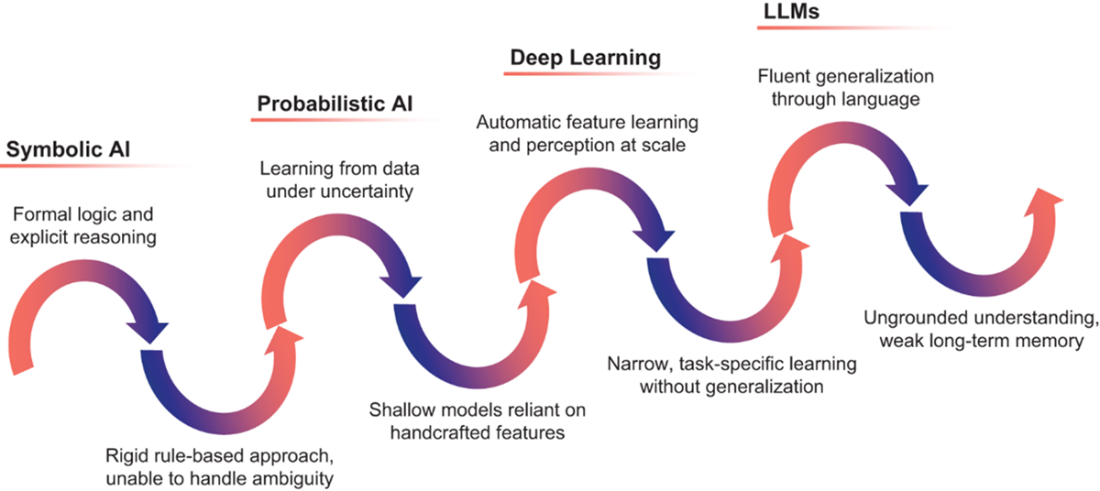
The timeline contrasts successive AI approaches and the limitations that prompted new techniques. section 1.4.5
The Turing Test evaluates machine behavior through conversation: a judge tries to distinguish a hidden machine from a hidden human. It makes intelligence an observable question, but successful imitation leaves open what, if anything, the system understands. Modern language models sharpen this distinction because fluent explanations can resemble reasoning even when the system cannot verify its claims or judge their applicability. section 1.3.4 section 1.1.3
Fluency and verification
A language model may clearly explain a medical treatment and answer follow-up questions. That fluency does not establish that it can verify the explanation, relate it to a reliable model of the body, or decide whether it applies to a particular case. section 1.1.3
Failure alone does not settle the question of machine intelligence either. Current systems show flexible competence in reasoning, adaptation, and problem solving, yet their performance can be unreliable and dependent on prompts, training data, tools, and surrounding systems. They also lack features associated with human cognition, including an embodied perspective and continuous lived history. Their abilities may therefore warrant a qualified account of intelligence without equating them with human thought. section 9.0 section 9.5.6
These distinctions matter in practice. AI-generated drafts, summaries, code, and answers influence professional decisions, while scientific systems can surface patterns for researchers to test. Convincing output should be assessed in context, with verification, oversight, and human judgment suited to the consequences of error. section 1.0 section 1.1.4 section 8.4.2
Scientific exploration
AlphaFold learned from known protein structures to predict three-dimensional shapes from sequences. Its use illustrates how AI can help researchers explore complex relationships and guide further testing. section 8.4.2