A large language model (LLM) is a generative model trained on extensive text data to create natural-language content. Unlike predictive or classification models, it generates content rather than simply assigning a class. section 2.0 section 2.6
Figure 2.1 The difference between generative and predictive models

Compare how generative models create content with how predictive and classification models classify it. section 2.0
An LLM combines training data, model architecture, and training for a particular use case. Fine-tuning further adapts a model to a domain or task; GPT models use transformer architecture and can scale to billions of parameters. section 2.0 section 2.6
Figure 2.2 The main elements that describe an LLM
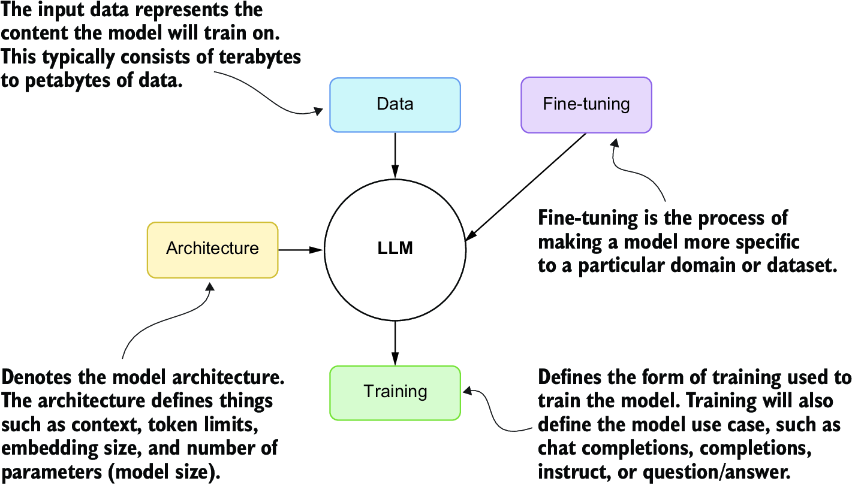
Use the diagram to see the main elements that describe an LLM. section 2.0
ChatGPT as a chat-completions model
ChatGPT is trained on public internet data and refined through training strategies, including reinforcement learning with human feedback, to support chat completions. section 2.0
LLMs can power chatbots, assistants, and agents. They can be accessed through APIs or explored locally with tools such as LM Studio; prompt engineering helps shape more effective requests. section 2.6




































































