A content-generation app can draft a blog post in a customer’s voice, yet still invent a fact or miss the brand’s tone. A language model (LM) makes such an app flexible; it does not make its output automatically accurate or ready to publish. Product value depends on how the model is selected, adapted, evaluated, and placed within the application. section 5.0 section 5.2
LMs learn from text that may span literature, news, user-generated content, multiple languages, and code. That breadth helps them work across styles and tasks, including drafting, summarization, translation, and question answering. It also sets limits: a model may be fluent without knowing a specialized domain accurately. Gaps or bias in training data can surface in customer-facing responses. Here, LM includes both large language models and smaller language models; bigger is not automatically the right product choice. section 5.1.1 section 5.0
Choose the LM’s role before choosing a model:
- Direct user interaction gives people room to request varied content, but leaves inputs and outputs hard to control. Check linguistic quality, safeguards, factual reliability, and response time. section 5.2.1
- Programmatic use passes model output to other software. Assess whether generated code or other outputs could harm systems when acted on. section 5.2
- A well-defined backend task can offer more control when open-ended conversation is unnecessary. section 5.2 section 5.5
Figure 5.5 Three common LM usage patterns
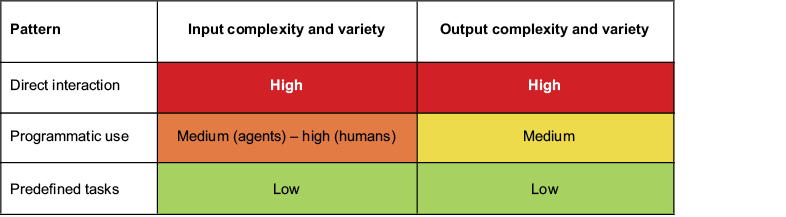
Compare direct interaction, programmatic use, and specialized tasks by how varied their inputs and outputs may be. section 5.2
From fluent copy to a dependable feature
A client asks the content app to make a product description more playful, then turn it into a formal press release. Instruction-following supports both edits, but brand fit and factual accuracy still need checking. The team can first test candidate models against its own content, then add outcome-oriented measures such as brand alignment, readability, and accuracy. Public benchmarks help narrow options; they cannot replace evaluation against the intended customers and tasks. section 5.1.3 section 5.4.2
Start selection with hard constraints such as client privacy requirements, then weigh quality, cost, deployment, customization, and the team’s capacity. Prompt engineering can adjust behavior quickly; retrieval-augmented generation can supply context; fine-tuning can pursue more consistent specialized performance when lighter approaches fall short. None removes the need to inspect failures and iterate with user feedback. Treat the LM as one component alongside data, user experience, and governance—not as the whole product. section 5.4.1 section 5.5 section 1.3.2


































































