A large language model (LLM) is a neural language model trained on vast text corpora to predict the next token. It generates fluent continuations by reproducing statistical associations learned during pretraining, rather than applying explicit rules. section 1.4
Prompt responses are probability-weighted continuations of familiar patterns. This can simulate logical reasoning, but performance becomes less reliable when scenarios are novel or require intricate multistep relationships. section 1.4 section 1.5
LLMs occupy several stages of a language-model development workflow:
- Start with a pretrained language model, optionally apply instruction fine-tuning, and then add reasoning training or preference tuning. section 6.1
- Improve reasoning through training-time scaling, inference-time scaling, or a combination of both. section 6.1
Pattern matching that resembles reasoning
For “The capital of Germany is…”, an LLM produces “Berlin” through a strong learned association. For “All birds can fly; a penguin is a bird,” it may produce a logically appropriate answer without explicitly checking contradictions. section 1.4 section 1.5
Figure 1.6 Contradictory premises lead to a logical inconsistency. From “All birds can fly” and “A penguin is a bird,” we infer “A penguin can fly.” This conclusion conflicts with the established fact “A penguin cannot fly,” which results in a contradiction.
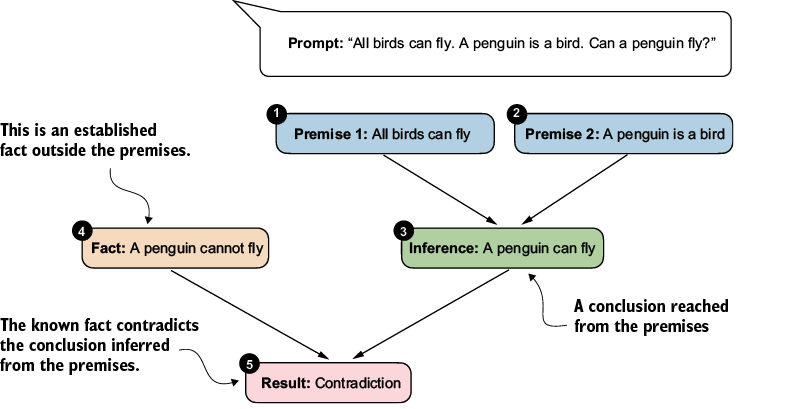
Trace how prompt premises can produce a conclusion that conflicts with background knowledge, exposing the difference between statistical completion and explicit contradiction checking. section 1.4


































































