A large language model (LLM) is a Transformer-based neural language model trained on very large text corpora. Its scale—often tens or hundreds of billions of parameters—supports natural-language understanding and generation across tasks. Transfer learning lets one pretrained model reuse linguistic patterns learned from generic objectives, such as masked-token or next-token prediction, for tasks including relation extraction. section 1.2 section 5.3
An LLM fits into data-driven systems through several complementary roles:
- Extracts domain entities and relationships from scientific publications, clinical reports, databases, and other unstructured text to expand knowledge graphs. section 1.3 section 1.5.1
- Interprets complex questions, translates natural language into graph queries, and summarizes structured results as readable answers. section 1.3 section 1.5.3
- Uses prompt-based inference for rapid customization or fine-tuning when prompts alone cannot provide sufficiently accurate or stable domain-specific output. section 5.3.1 section 5.4
- Requires validation and grounding because generated responses may hallucinate, become stale, lack domain context, or remain difficult to explain. section 1.0 section 6.4
Ontology-grounded entity disambiguation
An end-to-end biomedical workflow sends unstructured text to an LLM-based named entity recognition component, searches an ontology for candidate matches, and asks the model to disambiguate them using summarized ontology paths. For “Zika,” candidates can include Zika Virus, Zika Virus Infection, and Congenital Zika Virus Infection. The system combines the LLM with SNOMED, full-text search, and shortest-path analysis rather than relying on generation alone. section 8.4 section 8.5
Figure 5.4 The two roles of LLMs in KG generation from textual data: the prompt-based approach (upper branch) and the fine-tuning approach (lower branch)
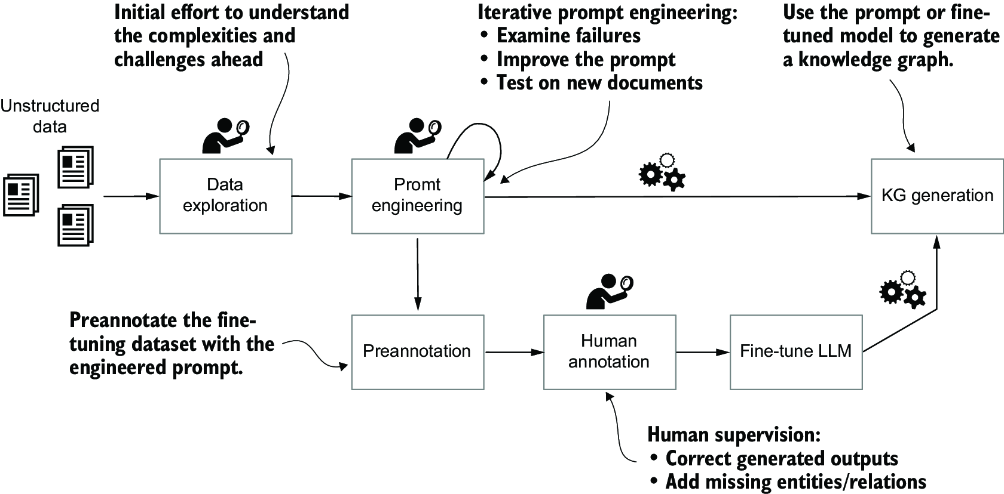
Use this workflow figure to compare prompt-based inference with fine-tuning for extracting entities and relationships from text. section 5.3.1


































































