liveBook · Manning

Language model

As explained in Build a Text-to-Image Generator (from Scratch)

A language model is a model that processes or generates human language, typically as sequences of text.

A language model generates text as a sequence. In min-DALL-E, the sequence-generation pattern is used to produce image tokens instead: a text prompt is tokenized and encoded, then a BART decoder predicts 256 image tokens autoregressively. A VQGAN decoder turns those tokens into an image. section 12.1.2

Figure 12.3 The image generation process in min-DALL-E to generate an image from a text prompt
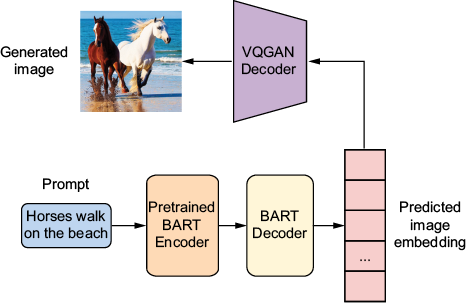
Follow the path from text prompt to generated image. section 12.1.2


How Build a Text-to-Image Generator (from Scratch) covers it

How deep it goes
Traces tokenization, BART encoding, autoregressive decoding of 256 image tokens, and VQGAN reconstruction without detailing language-model internals.
Examples
Follows a text prompt through BART to 256 image tokens, then decodes them into a high-resolution image.
What you can do after
Understand how autoregressive language-model-style decoding can generate image tokens from a text prompt.
How it connects
Connects language modeling with BART, transformers, text tokenization, and VQGAN-based image-token decoding.

Also explained in

Compare how 67 books explain language model →

Related concepts

This explainer was generated by Manning's knowledge graph from the text of Build a Text-to-Image Generator (from Scratch). The section links point to the parts of the book it draws on.
































































