A large language model is a neural model built on transformer architecture and trained on extensive text to predict likely next words. From learned patterns, it processes context, follows instructions, and generates language for tasks ranging from factual answers to creative writing. section 1.1
Treat generated language as useful but not automatically reliable because an LLM can:
- Return outdated information after its knowledge cutoff. section 1.2.2
- Produce confident hallucinations, including fabricated legal citations or incorrect identifiers. section 1.2.3
- Lack access to private, proprietary, or specialized domain information unless that knowledge is supplied externally. section 1.2.4
Use an LLM in retrieval-augmented generation as a generator rather than as the sole knowledge source. A retriever supplies relevant external facts, allowing a smaller, faster model to compose answers from provided context and reducing—but not eliminating—hallucinations. section 2.1.2 section 1.5
Use LLMs beyond response generation: guided or fine-tuned models can extract structured information from documents, support knowledge-graph construction, and generate Cypher queries from natural-language questions. section 6.0 section 4.7
Pattern completion and instruction following
Given “Never gonna,” an LLM may generate “give you up,” reflecting learned associations. Asked for a haiku about a specified topic and style, it can follow the instruction and produce a creative response. section 1.1
Figure 1.1 LLMs are trained to predict the next word.
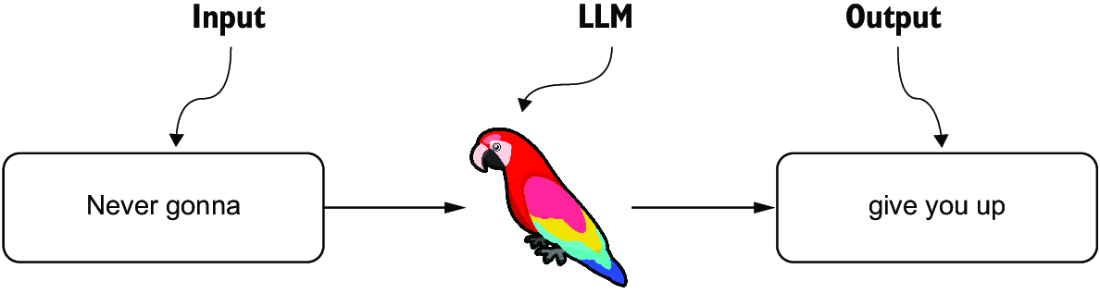
Visualizes next-word prediction, the basic training objective underlying language generation. section 1.1


































































