A large language model (LLM) is a machine-learning model that predicts plausible language. Transformer architectures made it possible to train models such as GPT and BERT on massive datasets, producing strong language-generation capabilities. In data storytelling, LLMs provide textual context through commentaries and annotations rather than replace judgment about the story or its audience. section 7.4 section 7.0
Choose how to extend an LLM according to the information it must know:
- Use ChatGPT directly when the task does not require specialized domain information. section 7.4
- Apply fine-tuning when a pretrained model should adapt to a domain using task-specific prompt–completion pairs. section 7.6 section 7.4
- Use retrieval-augmented generation (RAG) when generation must incorporate domain knowledge from an external vector database. section 7.6 section 7.4
Adding context to a data story
A data storyteller can ask ChatGPT to generate a commentary or explain an anomalous chart point with an annotation. The result should be calibrated to the audience and reviewed before inclusion. An entirely AI-generated story might invent a political scandal, illustrating why human-in-the-loop validation matters. section 7.1 section 10.1.1
Figure 7.10 A criterion to establish whether to extend an LLM or not
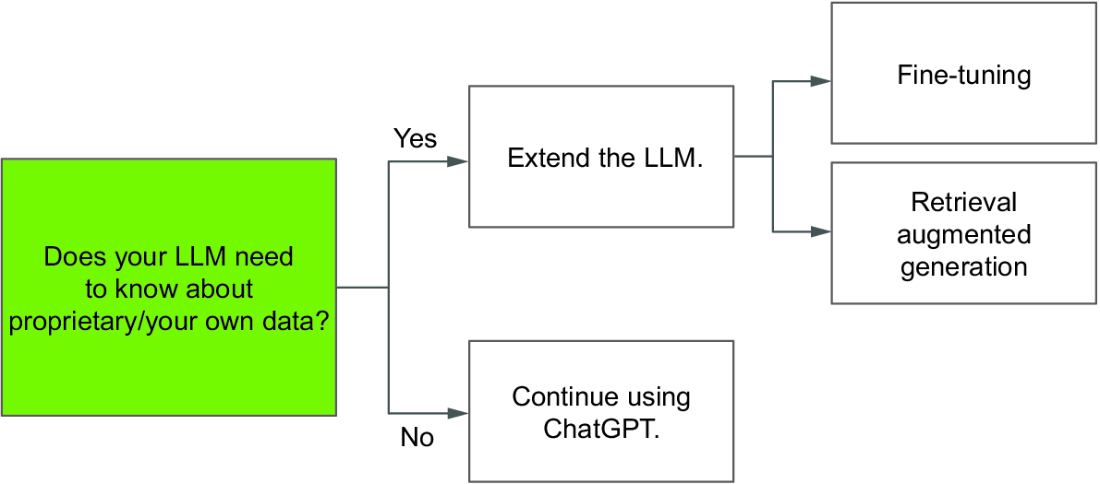
Use the criterion to decide whether direct LLM use is sufficient or whether domain knowledge requires fine-tuning or retrieval-augmented generation. section 7.4


































































