An AI agent is a software system that turns model reasoning into goal-directed behavior. Rather than only producing a response, it receives an objective, plans a next step, uses available tools, observes results, and continues until it reaches a goal or limit. In security workflows, it interprets artifacts and proposes which findings deserve routing, deprioritization, or escalation. section 1.3.1 section 1.5.2
An agent combines a reasoning model with orchestration and explicit operating components. The model supplies language and reasoning; tools perform measurable actions; memory preserves context; a controller selects next actions; and artifacts durably record inputs, outputs, and decisions. This structure distinguishes an agent from a one-off LLM call or a fixed procedural script. section 1.3.1 section 2.3.1 section 2.2
Figure 1.4 An overview of AI agent systems. AI agents consist of 4 components that are orchestrated together to produce an outcome: 1) the model, which is a foundation model, 2) tools, which are functions that the LLM can use to interact with the world (e.g., custom functions, APIs, MCP servers), 3) memory, where previous interactions are stored either in the context window or in a vector database, and 4) the knowledgebase, where additional context (documents, old conversations, etc) are stored in a vector database.
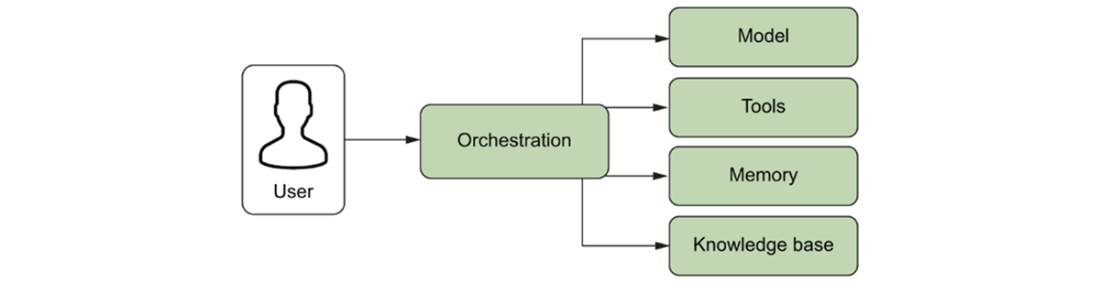
Inspect the model, tools, memory, and knowledge base as separately orchestrated parts of an agent system. section 1.3.1
A controlled agent loop makes behavior inspectable:
- Receive human intent and structured artifacts as inputs. section 1.5.2
- Reason about the next action, invoke a tool, and observe its result. section 2.2
- Record decisions, tool calls, observations, and outcomes as durable artifacts. section 2.3.1 section 2.3.3
- Use feedback to refine strategy, or stop when a goal or configured limit is reached. section 1.3.1 section 1.3.3
In an agentic pipeline, tools execute and produce artifacts, pipelines route those artifacts, and agents interpret their significance. This creates an adaptive, event-driven alternative to linear automation: reconnaissance, triage, and testing can respond to new data while preserving traceable handoffs between stages. Artifacts also let focused agents exchange outputs in multi-agent systems. section 1.4.3 section 1.3.3 section 3.2
Reconnaissance triage agent
After trusted tools finish reconnaissance, an agent can review saved output files without scanning or probing targets. It can flag unusual exposure, identify unexpected service combinations, group hosts with similar stacks, and surface legacy or internet-facing services for human review. Its result is a short, explained, recorded list of priorities—not an exploit or irreversible decision. section 2.7.1 section 2.7.3 section 2.7.5
Autonomy must remain bounded. Agents can misread scope, execute destructive actions, process sensitive data, or cross authorized network boundaries. Authorization, human approval gates, sandboxing, logging, and kill switches constrain consequences; humans define objectives and approve escalation. Auditability is therefore a safety property, not optional administration. section 2.6.1 section 2.8 section 1.4.3













































