An AI agent combines a model with an execution harness that selects and performs actions toward a goal. Unlike a text-only assistant, an agent can act on external systems, so mistakes can have consequences beyond the conversation. A prototype that calls a model can therefore grow into a distributed system with safety, reliability, and operational requirements. section 6.0 section 1.0
The agent loop distinguishes an agent from a fixed pipeline. The model can return a response or request tools; the harness validates and executes those requests, feeds results back to the model, and repeats until a final response or an iteration limit. Branching, tool execution, and feedback let the model continue reasoning as the task unfolds. section 10.9
A production-oriented request flow coordinates the loop with platform services:
- Validate the incoming message, then load the session and memory and assemble context. section 10.9
- Call the model. For tool requests, validate arguments, execute the tools, and return their results to another model call. section 10.9
- Filter the output, store the exchange, and return the response. Bound repeated tool use with an iteration limit. section 10.9
Figure 10.9 The complete agent loop. Each step corresponds to a platform service call.
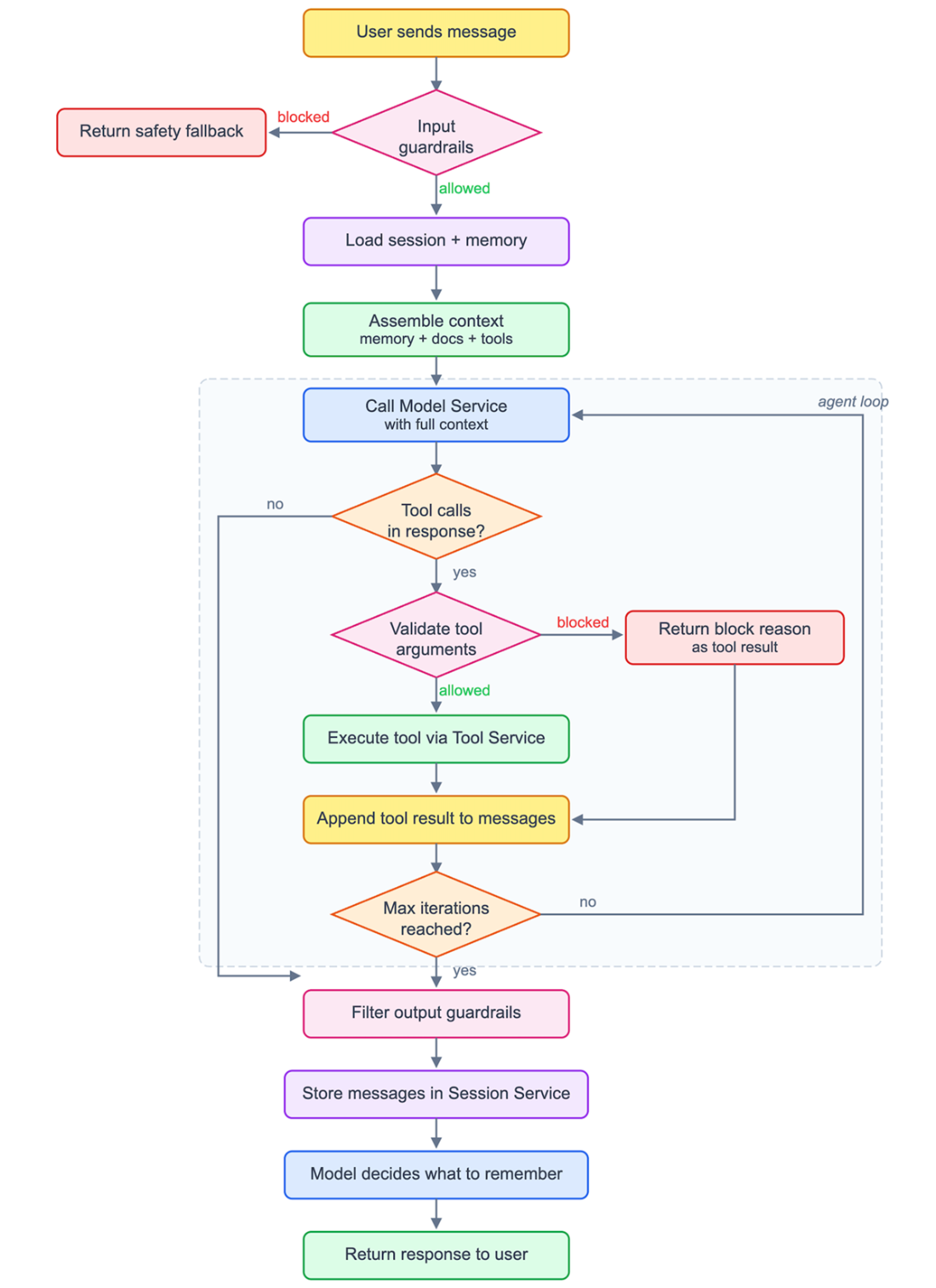
Trace the service calls, decisions, and feedback path in the complete agent loop. section 10.9
The surrounding services make actions manageable: a tool service provides registration, discovery, credential isolation, and reliability patterns; guardrails constrain actions; and observability records what happens. Persistent sessions, knowledge retrieval, and deployment infrastructure support the application without placing all of that machinery in the agent’s business logic. section 6.0 section 10.0
Healthcare assistant
A healthcare assistant can move beyond answering questions to scheduling appointments or submitting insurance verification. Each action starts a real process, so tool access, credentials, safety policies, and limits on repeated calls matter as much as the model’s response. section 6.0