An AI agent is a goal-directed execution unit that uses an LLM within a broader architecture for reasoning, planning, acting, and memory. Unlike a plain LLM responding to a prompt, an agent can pursue a task with some autonomy. Unlike a predefined workflow, it can adapt its actions as execution unfolds. section 1.2.3
Figure 1.4 AI agent architecture illustrating Agent = Model + Harness, where the model performs reasoning and generation while the harness coordinates execution, tools, memory, state, and environmental feedback
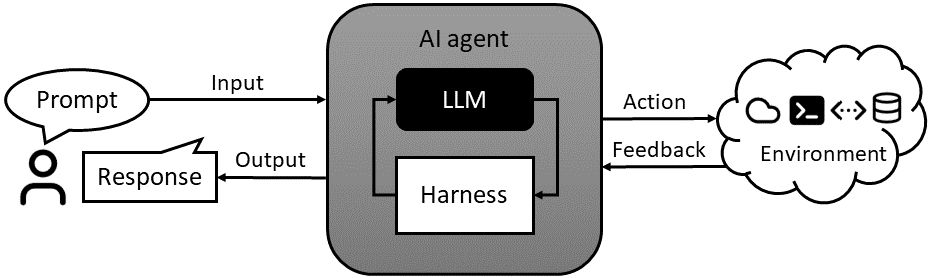
The model provides reasoning and generation; the surrounding harness coordinates context, tools, memory, state, and feedback. section 1.2.3
The harness connects the model to external resources and manages an iterative loop of reasoning, acting, and observing. It assembles prompts and context, exposes and executes tools, maintains execution state, and determines how results re-enter the context. Useful information can be stored in external memory for later recall. section 1.2.3
An agent operates within an agentic system: the application architecture that hosts and coordinates one or more agents. A single agent may retrieve knowledge, call tools, and maintain task state. A multi-agent system distributes work among specialized agents, either through direct communication or an orchestrator. section 1.2.4
Software development agents
A development system can divide work among planning, codebase inspection, coding, testing, and review agents. Specialization gives each agent a narrower role, focused context, and clearer tools. Coordination also adds latency and token costs, can propagate intermediate errors, and makes failures harder to diagnose. section 1.2.4
Tool access lets an agent retrieve live data and act on external systems. Function calling scopes predefined capabilities through schemas; a command-line interface provides access to host utilities; and the Model Context Protocol supports discovery and connection through a client-server architecture. Because tools can change external systems, use controls such as least-privilege permissions, argument validation, sandboxing, approval gates, and invocation tracing. section 4.7













































