An AI agent can turn a mistaken assumption into an action: it may retrieve the wrong data, send it to a third party, or close a case without escalation. Unlike a system that only generates an answer, an agent pursues a goal through multiple steps and can act through tools with limited human intervention. section 2.6.1 section 5.6 section 6.7
An agent uses AI models for reasoning and planning. Its control loop maintains context, chooses and executes steps, and connects to tools under configured instructions, policies, and permissions. Its autonomy is bounded by its deployment and access: an agent with local file access has a different reach from one limited to part of an inbox. section 2.6.1
An agentic workflow may use one agent or several coordinating agents. Unlike a predefined workflow that executes a user’s specified action, an agent can decide which information to gather and which tools to invoke. Agentic capabilities can be added across SaaS, API-integrated, and self-hosted adoption models; the deployment posture and degree of autonomy are separate governance decisions. section 2.6.1 section 4.8 section 2.8
Claims handling with persistent memory
A claims agent retrieves details of an earlier accident, assumes it is connected to a new windshield claim, and requests an unnecessarily extensive repair estimate. It also sends the customer’s personal details with the request. The failure combines an incorrect inference with an unsupervised data transfer. section 5.6
Autonomy changes the attack surface. Malicious content can influence an agent’s planning, tool choices, or objectives. In the disclosed EchoLeak attack, hidden instructions in an email induced Microsoft 365 Copilot to expose enterprise data without user interaction. Filters can block some attempts, but they are not an enforced security boundary. section 4.0 section 4.8
Controls should cover both individual actions and the full course of a task:
- Scope credentials and tool access; validate actions before execution and require approval for appropriate action tiers. section 4.8 section 5.6.5
- Constrain objectives and check whether a tool call stays within the approved purpose and lawful basis. Gate expansion with blocking, human review, or consent as appropriate. section 5.6.5
- Log tool and API calls, data accessed, consequential autonomous decisions, errors, and human overrides. Review traces for policy violations and regressions after updates. section 5.6.4
- Reassess the system when capabilities change: adding a customer database or refund tool can change the risk profile of the whole application. section 7.2.1 section 7.3.6
Figure 5.4 How an agent expands privacy risk during one task. The same action can create a new data use, a new recipient, a new memory, and another place that must be covered by deletion.
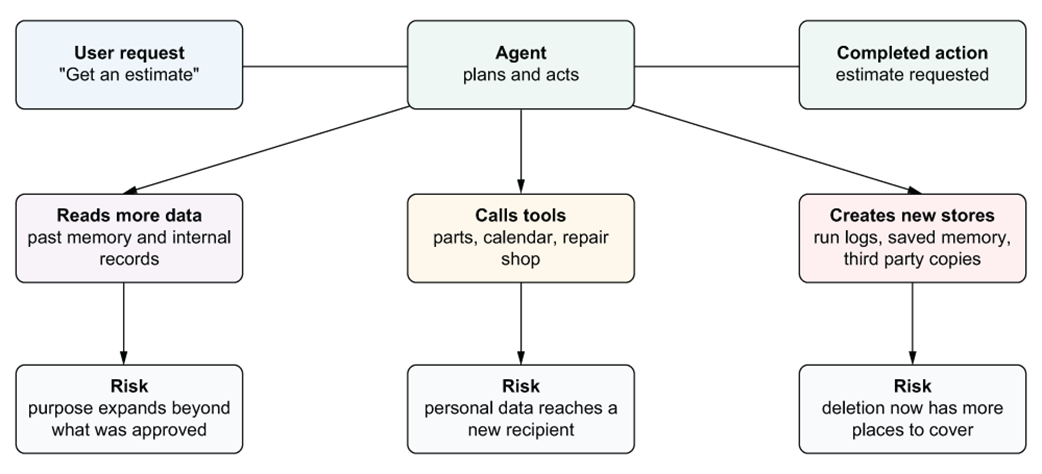
Follow how a single agent action can create a new data use, recipient, memory, and deletion obligation. section 5.6













































