An AI agent is a software component powered by a language model and assigned an identity, goals, and tools. In retrieval-augmented generation (RAG), agents replace a single, rigid search call with a workflow that can choose indexes, refine ambiguous queries, repeat searches, and ask for clarification. section 4.1 section 4.0
A production-oriented retrieval workflow uses agents to:
- Validate and triage the incoming request before searching. section 4.0
- Rewrite vague or technical user questions into effective search terms. section 1.5
- Select among vector and keyword indexes, or search multiple databases concurrently. section 4.0
- Use retrieved records as grounding so generated answers rely less on unsupported model output. section 4.0
- Balance accuracy against latency and token cost when adding agents. section 4.1
Comparing two products
For a question about the difference between Product ABC and Product XYZ, a basic search may fail by querying both products together. Agents can search for each product separately, then combine the retrieved information into an answer. section 4.1
Figure 4.1 We are now in the Retrieval stage of our RAG pipeline, which includes input validation, query triage, query rewriting, and search using agents.
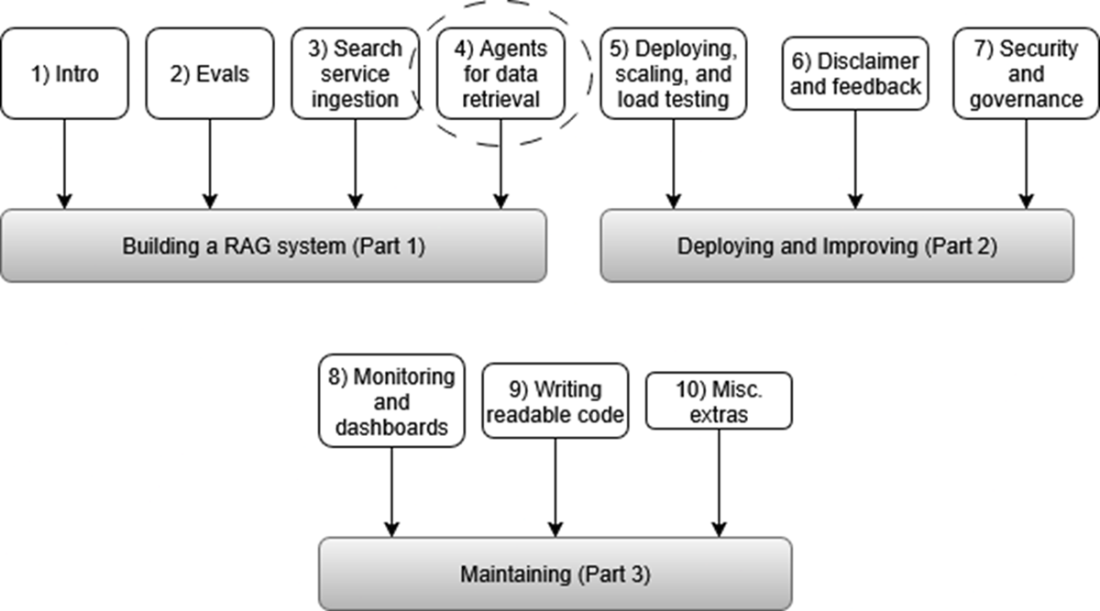
The retrieval pipeline connects input validation, query triage, query rewriting, and agent-based search into one operational flow. section 4.0