Machine learning (ML) is a subfield of artificial intelligence that enables computers to learn patterns and relationships from data without explicit programming for each case. Deep learning is a further ML subset that uses artificial neural networks to analyze large data sets. section 22.3 section 22.3.1
Classify ML by the feedback or labeling available during learning:
- Supervised learning trains on labeled examples and learns relationships between inputs and their labels. section 22.3.1
- Unsupervised learning trains on unlabeled data, discovers structure and patterns, and commonly groups data into clusters for later human interpretation. section 22.3.1
- Reinforcement learning interacts with an environment and learns from positive or negative feedback. section 22.3.1
- Semi-supervised learning combines labeled and unlabeled data as a middle ground between supervised and unsupervised learning. section 22.4
In network operations, ML and deep learning analyze historical and real-time network data to uncover patterns, anomalies, and operational insights. Their outputs can improve performance and security while automating routine decisions. Predictive AI forecasts future events, whereas generative AI creates new content from learned patterns. section 22.3.2 section 22.3.3
Operational applications
A network can use predictive AI to forecast traffic, provision resources before anticipated spikes, schedule maintenance before hardware failures, plan capacity, and identify likely security threats. Generative AI can support text generation, but networking use cases remain more limited than predictive applications. section 22.3.3 section 22.3.2
Learning examples
A supervised classifier learns from cat and dog images labeled accordingly. An unsupervised system receives unlabeled images, groups them by shared patterns, and leaves the final cat-or-dog interpretation to a human. section 22.3.1
Figure 22.10 Machine learning is a subfield of artificial intelligence. Deep learning is a further subset of machine learning using artificial neural networks.
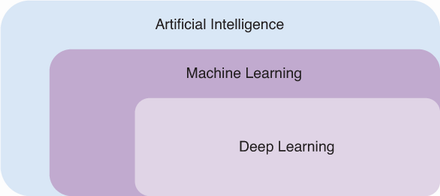
Shows the hierarchy connecting artificial intelligence, machine learning, and deep learning. section 22.3.1
Figure 22.11 Supervised machine learning. Labeled data is input into the ML algorithm, allowing it to learn the relationships between the data and the given label.
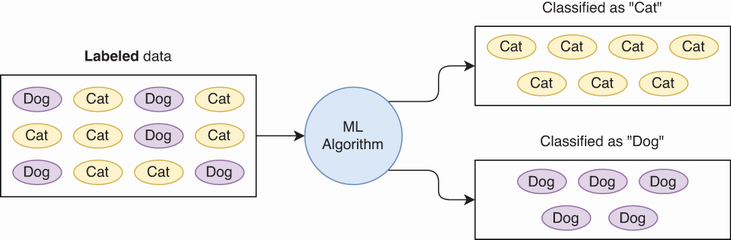
Visualizes supervised learning as labeled data entering an algorithm that learns input-to-label relationships. section 22.3.1









































