A growing online shop can collect more customer feedback and behavior data than its product team can interpret by experience alone. Machine learning offers a way to find patterns in that data and support decisions such as personalized recommendations. Its value is not the model by itself, but whether those patterns help people make better decisions. section 4.0
Machine learning relies on mathematical computation, so inputs must be numerical. Preparing raw text, images, or other data for a model involves choosing a numerical representation. That choice matters: a coarse representation may discard information needed for the task. Data-cleaning and representation skills can also differ substantially between modalities. section 3.1.1
Choose the approach around the problem, not the appeal of a model:
- Use explicit rules when a domain can be defined clearly enough to prototype quickly, produce predictable outputs, and begin collecting relevant training data. section 3.2.1
- Consider machine learning when real-world nuances and edge cases limit what fixed rules can cover. The nature and complexity of the learning problem should guide the choice. section 3.2 section 3.2.1
Figure 3.4 One-hot encoding provides a simple numerical (algebraic) representation of words.
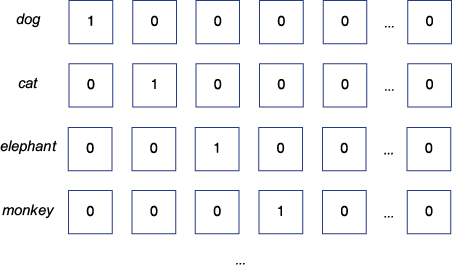
One-hot encoding makes the numerical-input requirement concrete: each word becomes a vector with one identifying 1 and zeros elsewhere. It is a simple but coarse representation, so ease of conversion should not be confused with preserving useful meaning. section 3.1.1
Forecasts that support inventory decisions
A supply chain manager risks waste from overstocking and lost customers from understocking. A demand-forecasting product can analyze historical data alongside market and weather trends. Its customer-facing promise should remain qualified: confidence intervals and the ability to override predictions help people use the forecast without treating it as certainty. section 12.2.2
Predictive AI can also classify data, structure unstructured information, and uncover relationships that are hard to see manually. Google search, spam filtering, and entertainment recommendations show how quietly such systems can become part of everyday use. For a product team, the practical question remains what decision needs support—and how to communicate the system’s limits to the people relying on it. section 4.0 section 12.2.2









































